Wednesday, May 31, 2006

Why No Wi-Fi?

The City of New Orleans touts it free Wi-Fi access but many have trouble logging-on.

WiredNews.com has more:

"Everyone thinks the free service is working, somewhere," Thornton said. "We're just not exactly sure where."

New Orleans' Chief Technology Officer Greg Meffert said a thousand people use the system, which runs on donated equipment at 512 Kbps -- faster than dialup but not as speedy as broadband.

But Joe Laura, owner of local internet provider Superior Wireless, is not so sure. Laura said his thriving business is proof that not many people are using the city's free wireless. He's swamped with 95 percent corporate clients, a big increase from before Hurricane Katrina. They gladly pay for his service, he said, because the free one is inaccessible or weak.

"The city is making it sound like everyone can have free access," he said. "But with New Orleans the way it is right now, we have problems even helping an RV park with full connectivity." Laura does not think the problem is unique to New Orleans. Other cities are struggling, too. "Hooking up an entire city with free Wi-Fi access is just not logistically possible, especially with the state our city is in."

Read the whole thing.

Tuesday, May 30, 2006

Petula Clark Is Downtown

When you're alone
When you've got worries,
All the noise and the hurry Seems to help, I know, downtown
Just listen to the music of the traffic in the city
Linger on the sidewalk where the neon signs are pretty
How can you lose?
The lights are much brighter there
You can forget all your troubles,
forget all your cares and go Downtown,
things'll be great when you're Downtown,
no finer place for sure,Downtown,
everything's waiting for you...

Hyatt Hotels is planning a major overhaul of downtown New Orleans.
Under the plan, two state office buildings, city hall, the city hall garage, the New Orleans Shopping Center and parts of the Hyatt would be demolished to make way for a park anchored by the National Jazz Center. City hall would move to the Dominion tower office building, state office buildings would be rebuilt at the site of the Civil District Court building, and the entrance of the Hyatt would move to Loyola Avenue.

The multi-level six-block park will include a 20,000-square foot jazz performance center with seating for 1,000 people, a smaller theater with seating for 300, a children’s theater, workshop, rehearsal studios available to local musicians and an archives for jazz research. The Canal Street streetcar would be extended down Loyola Avenue, connecting the park, sports facilities and public office complexes with the French Quarter and Convention Center.

The result will be a swath of green space leading from Tulane Avenue to the sports complexes of the Superdome and New Orleans Arena surrounded by modern buildings designed by renowned architect Thom Mayne in association with local architect Ray Manning and others. Developers on a panel convened by Hyatt and working with other stake holders from New Orleans envision an area that will be an internationally known destination for the arts and tourism which will be used day and night.

The New Orleans Jazz Orchestra will be based at the Jazz park, which will also be a destination for national touring jazz acts.The project could give lift to the adjacent medical corridor, to long-discussed notions of creating an entertainment district on South Rampart Street and to redeveloping the nearby Union Passenger Terminal. It could also help New Orleans lobby the National Football League for another Super Bowl.
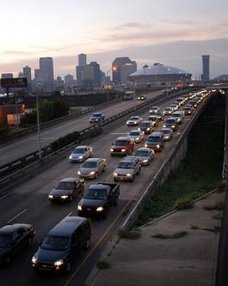
For thirty years, this part of downtown has been dominated by the Superdome and City Hall. It's typically a busy place because so many people do business there. What is missing is is the atmosphere that dominates so much of other parts of the city where people frequent for reasons other than business.

I also think that this will make New Orleans even more attractive for more sporting events in the future. New Orleans has hosted more Superbowls than any other city mainly because of the Superdome's proximity to the French Quarter. If an outdoor complex can be created around the Superdome, this will create another anchor downtown (the other being the French Quarter), the area between these two "magnets" can see growth in activity as people no longer look for the quickest way to get to the FQ, but rather visitors meander from one anchor to the other and visiting shops and restaurants in between. Much like a mall where shoppers go to Macy's and JC Penny but stop at some of the smaller shops in between. Look at it like the world's largest outdoor mall.

UPDATE: Seymour D. Fair at The Third Battle of New Orleans offers more background and insight.

Monday, May 29, 2006

It's Alive!

That's reaction of many residents of the Broadmoor neighborhood as it is on the comback trail.

Furthermore, not only are the residents moving back, they have a plan on how to make it even better.

Wednesday, May 10, 2006

Baby Makes Four

Monday brought a new addition to our family. Baby Girl Kinch was born on Monday the eigth at eight AM. Mother and baby are doing excellent.

Needless to say blogging will be light for the next week or two but I will continue to find time to keep my readers up to date on the rebuilding effort of New Orleans and the Gulf Coast.

Saturday, May 06, 2006

Home Alone

Residents of the Lower 9th Ward are now allowed to return.

People will probably be able to return home to live in part of the Lower 9th Ward next week for the first time since Hurricane Katrina, but there's no telling when the worst-damaged part of the neighborhood can reopen, New Orleans Mayor Ray Nagin said Friday.

If water test results expected Monday are clean, he said, people can return -- and get to work on repairing their homes and having trailers delivered -- immediately afterward in the section of the neighborhood between Claiborne Avenue and the Mississippi River.

His "look and stay" policy, replacing the "look and leave" policy in the Lower 9th, "allows you to rebuild," Nagin said.

Nagin said he got word Friday from the Sewerage & Water Board and Entergy New Orleans that the sewer, power and natural gas systems are in shape to provide service to at least 85 percent of the homes in the Lower 9th, where a breach of the Industrial Canal during Katrina allowed floodwaters to rush in, pushing hundreds of homes off their foundations.

Nagin said he did not know how many houses are expected to be reopened in the area, which is nearer the river and therefore higher than the section on the lake side of Claiborne.

"The area on the other side of Claiborne was the most heavily damaged," he said.

The next hurricane season is less than a month away.

"I think that, based upon what has happened to this city, we're moving as fast and as quickly as we can, considering that Entergy's also in bankruptcy," Nagin said.

Thursday, May 04, 2006

Survivor Building

BuildingGreen.com's article called " Passive Survivability:A New Design Criterion for Buildings" is interesting in that it promotes an idea buildings should be able to survive natural disasters.

In December 2001 an editorial in EBN introduced the concept of “passive survivability,� or a building’s ability to maintain critical life-support conditions if services such as power, heating fuel, or water are lost, and suggested that it should become a standard design criterion for houses, apartment buildings, schools, and certain other building types
This is a noble idea, but it needs to be limited to situations survivability is needed most.
David Eisenberg, whose organization, DCAT, has been working to integrate aspects of sustainability into building codes for the past ten years, points out that the purpose statement in the International Building Code states that codes should “safeguard public health, safety, and general welfare from hazards attributed to the built environment.� “When a building is unable to provide a safe and habitable environment,� says Eisenberg, “it fails to meet this standard of responsibility.� He believes that this should apply whether all of the building’s assumed utilities are functioning or not. “We should not be designing, approving, and constructing buildings that kill people when they are disconnected from their external utilities,� Eisenberg told EBN.
But people need to be aware that survivability has its limits. If a shelter is located too close to the shoreline and is vulnerable to stormsurge, no amount of engineering will be able to keep out the water. On the other hand, there are things that architects an engineers can do.
  • Locate shelters on sites that are high enough to avoid flooding.
  • Design for wind loads that far exceed current building codes.
  • Provide for back-up emergency power with enough fuel for several days.
  • Incorporate an independent sewer system that can operate with the municipal sewer system out of action.
  • On-site storage of potable water for several thousand people for several days.
Many in the media like to view the Superdome as a failed experiment to provide shelter during a massive storm. On the contrary, it was quite successful. No one died at the Superdome as a result of the storm. The misery at the Dome was a result of people being stuck in a substandard environment for several days. The only shortcoming the building had was that the the toilets were connected to the city sanitation system. And when that failed, the toilets failed to flush. The other was power. But while being stuck in 90+ degrees climate is unpleasent - my family wasn't much better off in Baton Rouge - it is not life-threatening except for the infirm who should not ride out a strorm anyway.

Survivability is not so much a design and engineering challenge but rather a budge challenge. We as architects and engineers can design building to withstand 200 mph winds, incorporate emergency power and build sanitation systems. The real problem is how will it be paid for. Unfortunately my degree was in architecture, not finance.

Wednesday, May 03, 2006

Follow Me, You Go First

The Wal Street Journal online has an article about Andres Duany and DPZ's Gentilly charette. The writer mostly covers matters already hashed out in the media about the role of New Urbanism but later there is a paragraph concerning the rift between the New Urbanists and Modernists.

"Architecture in which the answers to the future only live in the past represents a limited world view," says Reed Kroloff, dean of the school of architecture at Tulane University. As part of Mayor Ray Nagin's Bring New Orleans Back Commission, Mr. Kroloff objected to Mr. Duany's participation in New Orleans. "We've got great planners here," says Mr. Kroloff, who is no longer associated with the city's rebuilding efforts. "We don't need an out-of-town firm."

While agreeing with the New Urbanists on several planning concepts -- mixed-use development, higher density and walkability among them -- Mr. Kroloff argues that the redevelopment of New Orleans must be guided by more contemporary planning. For instance, he objects to the New Urbanists' fondness for town squares, arguing that public green space should follow the natural pattern of the landscape.

Mr. Kroloff is doing here what he as always been doing, critisizing the work of other architects and planners while actually doing little or no work himself. Notice how Mr. Kroloff says in broad terms what needs to be done but offers no specifics. At least Mr. Duany is showing residents what the possibilities are for their rebuilt neighborhoods.

This response from one resident sums it up nicely.

"I don't give a flip what you call it," says Nikki Najiola, a member of the civic-improvement group who applauded Mr. Duany's concepts for Gentilly. "Just get me back into my house."

On the Waterfront

When Marlon Brando once said "I coulda had class. I coulda been a contender. I coulda been somebody, instead of a bum, which is what I am, let's face it.", he could have been talking obout modern-say New Orleans. But if some developers have their way, New Orleans could once again have class.

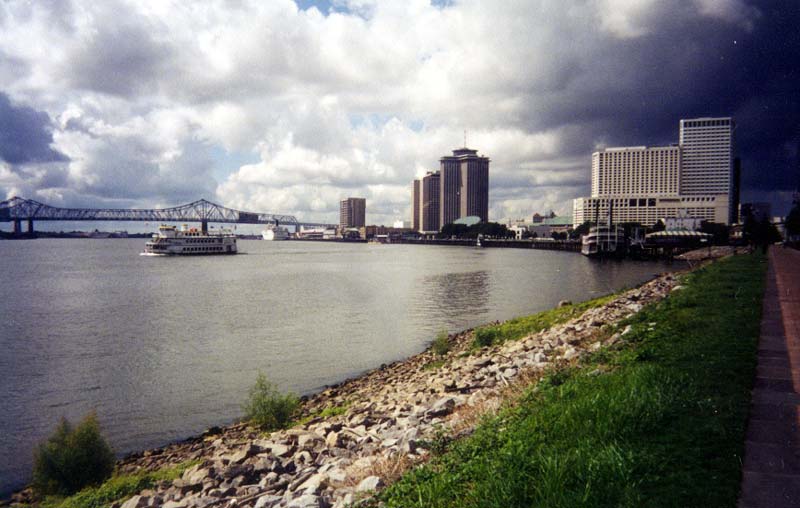
After years in the making, a plan to transform the riverfront now looks like a vital nugget in the city's rebuilding. Planners want to tear down warehouses and wharfs and build riverside promenades, condominiums, a cruise ship terminal, a river research center and museum, hotels and an amphitheater on the big crescent bend in the river _ hence, the Crescent City _ to give audiences sweeping views of the New Orleans skyline. Plans call for public and private funds for the projects, which could cost well over $300 million to complete.

"The river and riverfront were the key to the founding of this city, and similarly I think it's the key to the future," said Douglas Meffert, a Tulane University river studies professor involved in the riverside research center. "I think we need to think of the river as our front yard again."

That doesn't mean there wont be difficulties.

But the difficulties of riverfront development are in plain view: A panorama of vacant buildings _ a power plant, factories, warehouses _ overrun with weeds and pigeons.

There have been successes _ at least before Katrina struck. The Rouse Co., the national developer, counted the Riverwalk Marketplace mall as one of its more profitable properties; cruise ship and steamboat companies plied the river; and a sprawling riverfront convention center buzzed with activity. Most of that development was sparked by a World's Fair in 1984 centered on the Mississippi.

But not everyone is buying into this future-by-the-river scenario. Neighborhood groups worry the city's soul would be marred if glitzy condos for out-of-town snowbirds and malls replace the old riverfront.

"New Orleans was founded as a port city in the French Quarter, and to see maritime activity going on there to this day is very exciting," said Nathan Chapman, president of Vieux Carre Property Owners, Residents and Associates Inc., a group that looks after the wishes of French Quarter residents and businesses.

Attempts already have been made to raise the height limit of buildings from 50 feet to 75 feet to accommodate the planned development, said Chris Costello, president of the Faubourg Marigny Improvement Association.

"To go up an extra 25 feet makes it very egregious in our neighborhood," Costello said. The Faubourg Marigny is made up of winding streets and Creole and shotgun cottages with lush backyards immediately down river from the French Quarter.

Instead of fixating on new development, the city should focus on repairing blighted property and turn that into the living space that is so urgently needed, Costello said.

It shouldn't be impossible to overcome these obstacles. In fact, the concernes stated above should be look upon a constraints that will make the developement much more attractive. But if the investors are simply looking to make a quick buck instead making a long-term investment in the city, they might find themselves being made an offer they can't refuse.

Tuesday, May 02, 2006

More Gut(ter) Politics

An update to an earlier post regarding the deadline for gutting homes.

A week after the New Orleans City Council unanimously approved a law requiring homeowners to gut, clean and board up their flooded houses by the first anniversary of Hurricane Katrina or risk having the city seize and demolish them, a majority of council members appeared to back off the measure Saturday, saying the Aug. 29 deadline may be too soon and in any event should be flexible.
The Times-Picayune has more.

Get Outta Dodge

Mayor Ray Nagin has released the city's revised evacuation plan.

The new emergency preparedness plan, a work in progress, will not include the opening of the Superdome as a refuge of last resort.

Instead, the city, state and federal government will participate in an effort to move an estimated 10,000 residents without transportation to state shelters outside the area by bus or Amtrak train. The train will be reserved for "special needs" residents with medical conditions and the elderly.

Residents needing transportation will be picked up by Regional Transit Authority buses at locations throughout the city and driven to the Ernest N. Morial Convention Center, where they will be processed and then driven by bus to shelters, either in RTA buses or in buses provided by the state.

Nagin said U.S. Department of Homeland Security Secretary Michael Chertoff intervened to get Amtrak participation in the evacuation plan, and also is assisting in getting commercial air carriers to hold off on canceling flights out of the city, or even provide special planes, to evacuate tourists and others who already have tickets to fly out of the city.
This is an improvement over the previous plan which was to get out of town, and if you didn't, you would die.

You can view a graphic of the plan here.