Showing posts with label population. Show all posts

Thursday, February 08, 2007

U-Haul; We Bawl

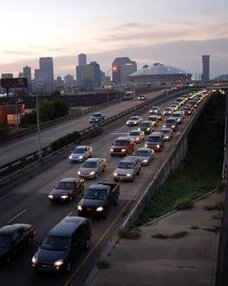
Fed up with the pace of recovery (or lack thereof), many New Orleans residents are pulling up stakes and gettin' outta Dodge.

A year and a half after Hurricane Katrina, an alarming number of residents are leaving or seriously thinking of getting out for good.

They have become fed up with the violence, the bureaucracy, the political finger-pointing, the sluggish rebuilding and the doubts about the safety of the levees.

"The mayor says, `Come back home. Every area should come back.' For what?" said Genevieve Bellow, who rebuilt her home in heavily damaged eastern New Orleans but has been unable to get anything done about the trash and abandoned apartment buildings in her neighborhood and may leave town. "I have no confidence in anything or anybody."

A survey released in November found that 32 percent of city residents polled may leave within two years. University of New Orleans political scientist Susan Howell, who did the survey, said more will give up if the recovery does not pick up speed.

In fact, figures from the nation's top three moving companies suggest more people left the area than moved into it last year.

"People are in a state of limbo. They're asking, `Is it worth it for me to stay? Is it worth it to invest?' If you don't feel safe, from crime or the levees, and you see destruction every day when you drive, it becomes discouraging," Howell said.

If there is an exodus, it could mean more than just a shrunken New Orleans. It could mean a poorer city, financially and culturally, and a more desperate one, too, since the people likely to leave are the most highly educated and younger.

Mayor Ray Nagin and Gov. Kathleen Blanco have urged residents to return under rebuilding plans with names like Bring New Orleans Back and Road Home. The mayor has warned that the recovery will take a decade and has urged people not to give up hope.

But New Orleans' population appears to have plateaued at about half the pre-storm level of 455,000, well short of Nagin's prediction of 300,000 by the end of 2006. And in many ways, it is a meaner city than it was before the hurricane.

In a related story, the Road Home Program continues to hand out checks at a snails pace.

Thursday, October 05, 2006

Survey Said!

Apparently the population of New Orleans is a wee bit smaller than the the Mayor has assumed.

NEW ORLEANS (AP) — Fewer than 190,000 people live in New Orleans, a fraction of the 454,000 people estimated to reside in the city before Hurricane Katrina hit last year, according to a survey released Thursday.

A spokeswoman for the Louisiana Recovery Authority, Natalie Wyeth, called the results of the door-to-door survey of households "the definitive, most precise set of numbers we've seen." But a local demographer, who has studied the city's population, dismissed figures as a "fairly significant underestimation."

"This is important, because funding decisions are based on population," demographer Greg Rigamer said....

According to the survey, an estimated 187,525 people lived in Orleans Parish, as of August. The figure did not include those living in college dormitories and jails and did not include people who work in New Orleans but live outside the city, said Dave Bowman, the project's lead from LRA.

The Orleans Parish population count had a margin of error of plus or minus 11.5 percent, the survey showed. Survey results, with even greater margins of error, also were released for hurricane-hit Jefferson, Plaquemines and St. Bernard parishes.

In those parishes, populations were estimated at 435,786 in Jefferson, with a margin of error of plus or minus 12.7 percent; 20,024 in Plaquemines with a margin of error of plus or minus 36.3 percent; and 25,016 in St. Bernard with a margin of error of 17 percent.

Pre-storm populations from July 2005 were estimated at 452,824 in Jefferson; 28,995 in Plaquemines and 65,364 in St. Bernard, according to the survey.

So whom to believe? According to this story in August, some "experts" estimated the population (at the time) to be between 210,000 and 235,000. On the other hand, some estimates had the population at 171,000 (apparently determined by the USPS) with an expected increase of 20,000 (by the same group that estimated the population to be 235,000) for the following six months. That would put the population in-line with the latest survey.

I suppose we can better estimate New Orleans population by asking the audience of "Family Feud".

Thursday, September 07, 2006

My City Is Smarter Than Your City


New Orleans finally ranks high in something positive.

The brainiest cities in the United States
Top 25 cities with more than 250,000 population, ranked by percentage of bachelor's degrees among residents 25 and older
City State Percent
Seattle WA 52.7
San Francisco CA 50.1
Raleigh NC 50.1
Washington DC 45.3
Austin TX 44.1
Minneapolis MN 43.2
Atlanta GA 42.4
Boston MA 40.9
San Diego CA 40.4
Lexington-Fayette KY 39.5
Denver CO 39.0
Charlotte NC 38.8
Portland OR 38.8
St. Paul MN 36.5
San Jose CA 36.1
Colorado Springs CO 34.9
Honolulu HI 34.7
Oakland CA 33.8
Pittsburgh PA 32.3
New York NY 32.2
Albuquerque NM 32.2
Anchorage AK 32.2
Omaha NE 31.9
Nashville-Davidson TN 31.7
Columbus OH 31.4
New Orleans LA 31.4

Tuesday, August 08, 2006

Where Have All The People Gone

The Times Picayune reports that the repopulation of New Orleans has slowed to a trickle.

The number of people who lived in the region before Hurricane Katrina and had come back as of June 30 rose by only 2,000, or less than two-tenths of a percentage point, compared with three months earlier, according to the data. If extrapolated, the figures suggest the metro area's population stood at less than 1.1 million at the end of June, compared with the region's pre-Katrina population of 1.5 million.

The estimates include 171,000 pre-Katrina New Orleanians who have returned to the city. Current estimates from city officials and others claim that a total 210,000 to 250,000 people are living in New Orleans, though they don't say how many of them were here before the storm and how many are workers who have come for the rebuilding.

I have my owne theory for this. We are currently between two rebuilding phases. The first phase involved people who have the wherewithall to rebuild with their own funds or insurance settlements. After almost a year, those who fall into this category should be about complete with their rebuilding efforts. The second phase will begin shortly as the money from the CDBG program will begin to be distributed.

Once the bulk of these funds start making their way into the construction pipeline, we should see s sharp uptick in the repopulation in about six months. Six months is the approximate time for a typical house to be renovated.

Tuesday, May 02, 2006

Get Outta Dodge

Mayor Ray Nagin has released the city's revised evacuation plan.

The new emergency preparedness plan, a work in progress, will not include the opening of the Superdome as a refuge of last resort.

Instead, the city, state and federal government will participate in an effort to move an estimated 10,000 residents without transportation to state shelters outside the area by bus or Amtrak train. The train will be reserved for "special needs" residents with medical conditions and the elderly.

Residents needing transportation will be picked up by Regional Transit Authority buses at locations throughout the city and driven to the Ernest N. Morial Convention Center, where they will be processed and then driven by bus to shelters, either in RTA buses or in buses provided by the state.

Nagin said U.S. Department of Homeland Security Secretary Michael Chertoff intervened to get Amtrak participation in the evacuation plan, and also is assisting in getting commercial air carriers to hold off on canceling flights out of the city, or even provide special planes, to evacuate tourists and others who already have tickets to fly out of the city.
This is an improvement over the previous plan which was to get out of town, and if you didn't, you would die.

You can view a graphic of the plan here.

Thursday, April 20, 2006

The Shrinking City On A Hill

Youngstown, Ohio has a similar to problem to New Orleans - no, 80% of Youngstown didn't flood - in that it has a shinking population and therefore the city must shrink in size. There the similarities end.

For one, Youngstown decline has occured over time with people choosing to live elsewhere. In New Orleans, people were forced to move away overnight and most still wish to return. That doesn't mean that we can't learn from Youngstown's study of how to deal with it's steady decline.

Last year Youngstown 2010--a partnership between the city's planning department and Youngstown State University--unveiled a comprehensive plan to reduce nonessential infrastructure, attract new businesses, and rehab deteriorated and abandoned spaces. In fact Youngstown is the first city in the United States to adopt this disarming approach to the problems of population decline. "It's politically and professionally uncomfortable to face the shrinkage of a city or region, even though it may be staring you in the face," says Frank Popper, an urban-planning professor at Rutgers and Princeton universities. "I think it's enormously brave and creative and innovative of Youngstown to be taking on this task."
One of the city's conclusions was to recast itself.
But if Youngstown's residents don't need housing, people from neighboring regions do. Ultimately the city may have to surrender to its location and become a bedroom community for Cleveland and Pittsburgh, each about 70 miles away. So in the end growing smaller may transform Youngstown into something else, says Charles Waldheim, a University of Toronto architecture professor who participated in the most recent Shrinking Cities conference. "To the extent that northeastern Ohio has a market for housing," he says, "it seems that Youngstown's future is making itself available for the garden living of the suburb."
New Orleans problem is the opposite. A majority of the city's housing was rendered uninhabitable overnight and a large portion of that housing will not return anytime soon but many are trying.

During the mayoral campaign, a number of candidates hinted at shrinking the size of the city but none, with the exception of Rob Couhig, has proposed how this might be accomplished. Mr. must have been reading blog because he recommends stopping the city limits at the Industrial Canal. Unfourtunately some of the other candidates accuse him of wanting to deny some citizend of their civil rights.

Enough of the Bluster.

The city has within its means to simply unincorporate that portion of the city deemed not viable. Essential services would then be provided by the parish. The Sheriff would take on a more traditional role of law-enforcement, rather than just being the jail keeper. The education system is already parishwide. Fire protection could be provided by numerous volunteer fire departments. Sewer and water could also be provided by the parish as well as other functions such as the court system, garbage collection, street maintenence, permits and inspections.

Some might say this cenario is wasteful and redundent. Maybe, but Jefferson Parish operates this way and is quite prosperous. The real advantage of shrinking the city limits is that it will reduce the demands on city government allowing an already bloated government to shrink to better fit the size of the city.

This more efficient government could allow for lower taxes and create a more friendly enviroment for new businesses, better schools, more crime prevention and less corruption. These are all ingredients for a growing city, not a shrinking city.

So you see, in order to grow the city, we must first shrink the city.