Showing posts with label architects. Show all posts

Monday, December 11, 2006

Tell Me Where People Want To Go So I May Lead Them There

The Times-Picayune's art critic penned an article about the effort of Andrés Duany of DPZ and his efforts to recreate New Orleans one small piece at a time. Much of the article has been covered by this blog before so I wont belabor the point. Although one paragraph mentions something I think is important and should be discussed in more detail.

He dismissed showy, big-budget projects such as the "Reinventing the Crescent" plan as "silver bullet" solutions. New Orleans, he said, is historically addicted to them. The aquarium, Convention Center and world's fair were all silver bullets meant to save the struggling city. They were high-profile substitutes for more elemental changes to the municipal codes that, he believed, would have accomplished more over time. Duany puts great stock in municipal codes.
His objections, though, is tempered by the knowledge of what is really needed.
They were high-profile substitutes for more elemental changes to the municipal codes that, he believed, would have accomplished more over time. Duany puts great stock in municipal codes.
Taken independently he is correct. Taken as a whole he is wrong. New Orleans needs all these solutions. That is why I have consistently favored all of them even if it is with reservations.
All of the project Mr. Duany mentioned have improved the city though they have not solved all of the city's ills.

Bringing the city back will be a long-term and multifaceted slog through the cypress swamps. The journey will be hard, dirty and impossible without effective leadership. People like Andrés Duany are providing that leadership. But what makes his leadership so effective that he takes the effort to listen to the residents and brings them to where they wish to go.

Thursday, November 30, 2006

Snake Oil Salesmen

John Massengale has another post regarding the arrogance of our elite architects propose that they know what is best for New Orleans despite the wishes of New Orleaneans. Marianne Cusato writes about her encounter with one of these architects (academically speaking).

Sarah Lawrence College in Bronxville, NY hosted a symposium this weekend on rebuilding and the future of New Orleans. The speakers included the winner of Brad Pitt's Global Green Competition, representatives from Acorn Housing, several others involved with planning efforts and a few displaced residents who had relocated to this area.

I was on a panel with the winner of the Global Green Competition, Matthew Berman from Workshop/APD. I presented the Katrina Cottages as well as a house I designed at the UDA Treme/LaFitte charrette. In my talk I discussed the feedback we'd received from the residents of Treme/LaFitte. We heard from them that they liked the look of the Shotguns, but wanted the plans be adapted to modern living and they had to be practical and affordable.

After we each presented our work we had a Q&A with the audience. The members of the audience that were from New Orleans, passionately attacked the "award winning" Global Green design. They were outraged that this project had been selected. They were upset that it had no resemblance to the existing neighborhood, either with the architecture or the plan. One woman stood up and explained to the architect that the "Historic" buildings weren't old and out dated. They were REALLY well designed, NOT because of the balustrades, brackets and architectural details, but because of the tall ceilings, cross ventilation and the materials. She was great because she elevated the conversation away from style to practical common sense.

The residents in the room were disgusted that modern designs were being imposed on them. The architect admitted that the residents that he had spoken to didn't like the modern designs, but that didn't stop him from proceeding with his work. It seemed more about his personal design exploration, rather than a project based in reality or any form of practicality. The amazing thing about the day was that no one in the room, NOLA residents or even the SLC students, were buying it - or cutting him any slack.

One resident pointed out that the architecture could either support or destroy a community. From the planning of where buildings go to the interior plans of where the kitchen is located. He went on to tell the architect of the GG Design that his building would destroy the community and probably cause people to kill themselves.

The professor at the school that was moderating our panel tried to let the guy off the hook by asking the audience if they could set aside the site plan, which he admitted was really bad, but looked only at the buildings, would they be happier with the designs, the room spontaneously yelled out NO.

Then he went on to try and talk about the theory and academic approach of the modern design, I interrupted and challenged that this was a real world problem not an academic experiment, that it was the wrong approach to ignore the existing context and the desires of the people. Instead we needed to listen to what people are asking for and through design, build communities. The room erupted in applause. The professor went on to dismiss me by saying "Well yes, that might be the populous view, but...."

We have so many struggles in the work we are doing down on the coast, politics at every level, but after a day like today, hearing the passion in the voices of these residents, it was so clear how important it is that we are down there and working so hard. The people want what we are doing.

I've said all along that the rebuilding of New Orleans and the Gulf Coast must have the involvement of its residents because they know what is best for their community and they know what works down here. That is why I have commended the work of Adreas Duany and his urban planning charettes in many small communities and New Orleans. Not because I'm an adherent of his style of architecture but because he offers his expertise to the residents to help them realize THEIR dreams of what their neighborhood/town should be, not what he thinks it should be. And when it comes right down to it, that is what all real architects do. We are not here to impose our vision of someones home should be like at roadside salesman urging passers by to try their elixir, its good for them. Somewhere along the line, these academic architects lost site of that, if they ever had it at all.

The Classicist Blog has more input on Marianne Cusato.

Wednesday, November 29, 2006

Fiddlers On The Rooftops

Nero probably has a better reputation as a leader during times of disaster that many of our more notable architects in their (lack of) influence in the rebuilding. At least according to John Massengale at Veritas et Venustas. Unfortunately, these architects view themselves more as Pied Pipers.

The real heroes are the architects in the trenches doing the grunt of actually getting the renovations and repairs done without fanfare.
Those that are using the situation in New Orleans to promote themselves are only hindering our recovery and are leaches on society.

Friday, November 17, 2006

Sore Thumb

A politician once said that all politics is local. The same is true for good architecture. The redevelopment of the Jefferson Plaza Shopping Center is a good example of this axiom.

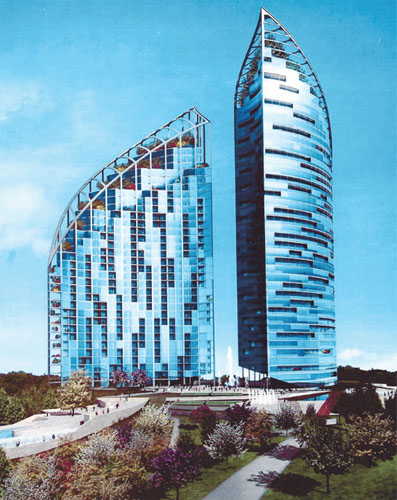
Conceptual renderings show a pair of curved glass-and-steel towers rising to points, with trees growing on rooftop terraces, fountains and pools on the grounds and intense lighting at the base of the structures, tapering toward the peaks. One tower might exceed 30 stories, far taller than any building for miles.

"It's going to be real dramatic lighting, along with dramatic water features," St. Raymond said.

The idea, however, is not receiving an entirely enthusiastic welcome in the neighborhood. Some nearby residents protest that it will exacerbate traffic problems, overshadow their houses and stick out, rather than stand out, among Old Jefferson's post-World War II wood frame houses.

So why is this design so unpopular? Seymour D. Fair offers his thoughts:
Architect Daniel Libeskind's above design was not what I had in mind--and I am not completely against multiple floored residential buildings at this site unlike many residents of the surrounding neighborhoods.
Daniel Libeskind is a great architect with soaring ideas for his designs, however like most starchitects, he is not in tune with the local vernacular and traditions. It is likely that the architectural firm was given a survey of the site along with some photos. With this information in hand, the design process begins. The architect may be able to come up with a design that will get noticed. But that is not always a good think. Severe birth defects get noticed too but no one wants one.

The developer and local residents would have been better served had a local architect been retained for the design. Perhaps the local architect's design wouldn't have been as radical but it probably would have been more contextual meaning more sensitive to the local environment and residents. This can't be done from a corner office in Manhattan.

Monday, September 25, 2006

Profiles in Design

The AIArchitect does a profile of one of my old college classmates, Trula Remson. I'm glad to see she is doing so well and it doesn't suprise me. She was one of only, I believe, two honors graduates in our class and the first to pass the ARE. All this despite our fifth-year professor saying that women aren't cut out to be architects.

I can also personally attest to her efforts to offer a lifeline to those who lost their homes, their offices, and their firms. A couple of days after Hurricane Katrina struck, I received an email from her suggesting that I contact the local AIA as they were compiling a list of firms willing to hire, either permanently or temporarily, displaced architects. After a handful of phone calls, all made from the mall where I was shopping with my family, I landed a job with a Baton Rouge firm till my current firm was able to establish temporary offices.

Thanks to her efforts and forethought, I never missed a paycheck.

Friday, August 25, 2006

Give Me That Old Time Modernism

The debate between New Urbanism and Modernism continues and Slate.com jumps into the ring again with this article about the new mixed use development on what used to be Stapleton (Denver) International Airport.

One of the largest new-urbanist developments under construction at the moment is in Denver. Stapleton is the site of the old Denver airport. When it's finished, the 4,700 acres will have 30,000 residents and 35,000 new jobs. The pragmatic developers—Forest City Enterprises—have provided something for everybody. In addition to dense residential neighborhoods of single-family houses, there are low-rise apartment buildings and condos, an 80-acre public park, several neighborhood centers, a regional shopping mall, an office campus, and a power center that includes a Wal-Mart and a Sam's Club. This is not doctrinaire new urbanism, but in the real world, planning doctrines must adjust.
The conclusion of the article is much the same as I've said in this blog that New Urbanism does not have to compete with Modernism. In fact, many areas in SE Louisiana can be both New Urbanist and Modernist. If only the Modernist will learn this lesson. The shortcoming (IMO) of the Modernists is they tend to focus soley on style whereas New Urbanist delve mainly into how cities function with respect to its residents. Disneyification is only an afterthought.

The second conclusion of this article, again, agrees with of many of my previous posts.
In July, the city put the rebuilding in the hands of the Greater New Orleans Foundation, a local charity. Abandoning the idea of a citywide visionary plan, the foundation will focus its reconstruction efforts at the neighborhood level. Whether or not this strategy will succeed—and in the current state of New Orleans, who knows?—it is not unreasonable. Levees and flood control infrastructure must be built by public agencies, but urban neighborhoods, as Jane Jacobs pointed out long ago, work best when created piecemeal by private households and entrepreneurs. So, a decentralized approach is definitely a good idea.
As I have posted before, the rebuilding of New Orleans should be driven by the residents and the planning process, slow as it may be, is going about it the right way. This city is almost 300 years old and it wont be rebuit in one.

Wednesday, May 03, 2006

Follow Me, You Go First

The Wal Street Journal online has an article about Andres Duany and DPZ's Gentilly charette. The writer mostly covers matters already hashed out in the media about the role of New Urbanism but later there is a paragraph concerning the rift between the New Urbanists and Modernists.

"Architecture in which the answers to the future only live in the past represents a limited world view," says Reed Kroloff, dean of the school of architecture at Tulane University. As part of Mayor Ray Nagin's Bring New Orleans Back Commission, Mr. Kroloff objected to Mr. Duany's participation in New Orleans. "We've got great planners here," says Mr. Kroloff, who is no longer associated with the city's rebuilding efforts. "We don't need an out-of-town firm."

While agreeing with the New Urbanists on several planning concepts -- mixed-use development, higher density and walkability among them -- Mr. Kroloff argues that the redevelopment of New Orleans must be guided by more contemporary planning. For instance, he objects to the New Urbanists' fondness for town squares, arguing that public green space should follow the natural pattern of the landscape.

Mr. Kroloff is doing here what he as always been doing, critisizing the work of other architects and planners while actually doing little or no work himself. Notice how Mr. Kroloff says in broad terms what needs to be done but offers no specifics. At least Mr. Duany is showing residents what the possibilities are for their rebuilt neighborhoods.

This response from one resident sums it up nicely.

"I don't give a flip what you call it," says Nikki Najiola, a member of the civic-improvement group who applauded Mr. Duany's concepts for Gentilly. "Just get me back into my house."

Monday, May 01, 2006

Echo Chamber vs. Retail Architecture


Two interesting articles this weekend put the different camps of rebuilding New Orleans in stark relief. The Christian Science Monitor covers DPZ's charette in Gentilly last week and the Washington Post writes about a group of Modernists architects and their grand designs for the rebuilding process.

First the Modernists:

Six proposals -- shown through intricate models, renderings, blueprints, sketches and politically charged factoids -- offer ways in which innovative design can revive a sense of community and build a stronger connection with nature.

In the re-imagined city, mangrove trees flourish in a vast, welcoming park; levee embankments are recast as picnic grounds; and civic pride finds expression in a public library so wildly creative that it would supplant the Superdome as the city's most notorious architectural icon. And children get a safe haven for a school.

The exhibition was organized in six weeks by a transatlantic brain trust including Reed Kroloff, Tulane University's dean of architecture and a member of the New Orleans recovery team; Aaron Betsky, an American who heads the Netherlands Architecture Institute in Rotterdam; and Tim Griffin, editor of Artforum magazine, the March issue of which serves as the exhibition catalogue.

Now the New Urbanists:

The Gentilly urban-planning method is called a "charrette," French for "cart," where architects, developers, environmentalists, sociologists, and transportation experts work directly with the people who will inhabit a community.

The idea is to design collectively a model that everyone can agree on, and it happens in a very short period - in this case, eight days.

The problem with the Modernists approach is that it's detached from the people affected by their proposals. On the other hand, the New Urbanists are meeting with residents, listening and offering practicle solutions to their situation. Putting a school under a hill and building zig-zag shaped building will not exactly pique the attention of the New Orleans citizenry.

But Andreas Duany has.

Residents with slab-on-grade homes were advised to covert their first floor into a garage and build a second floor with living quarters because the cost of raising the structure three feet is exorbitantly high.

Those with pier-and-beam homes were told to get started right away because the cost of raising a structure would rise with time. All were given architectural options that mimicked the many New Orleans styles.

"Do what you must do, but do it right," said Mr. Duany to the afternoon crowd assembled in a local church. "[City hall] will forgive anything if you do it right. You've got to get on with your lives."

But residents voiced concerns about building while the levees are still under repair. They are scheduled to be completed June 1, the start of the hurricane season, and should be able to handle Category 3 storms.

Duany assured residents that the levees would be excellent "because the honor of the nation depends on it. The levees are in better shape than they have ever been." But the reality, he said, is that rebuilding in New Orleans is a risk because the entire city is below sea level.

"We've been living with this risk all our lives so it's really a nonissue," said one resident.

"I just want people to know that they don't have to raise their homes at all," said another resident, referring to structures that are already three feet above the base flood elevation.

"Your flood insurance rates will be better if you do," added another resident.

"But they will go up rudely anyway," interjected Duany, as the designers buzzed in the background. "The simple fact is, a raised home looks better, has better curb appeal when it comes to resale."

Sure, slab-on-grade houses versus a raised-pier design and flood insurance is not the stuff of architecture school sketch problems but they are the kinds of things your average work-a-day architect deals with because it is what our clients deal with.

If we architects wish to play a positive role in rebuilding one of America's great cities, we need to be in the trenches, offering practical solutions for the rebuilding process, not trying to get the attention of design periodicals that most real people don't read.

Friday, April 21, 2006

Gentilly, My Lilly

The Times-Picayune finally has an article about the Gentilly Charette.

The media-savvy, 56-year-old Duany, who long ago gathered accolades and a measure of scorn after his design of the quaint Florida town Seaside, is tackling myriad planning questions in Gentilly. He is presiding over hearings, including one Thursday night, and work by dozens of volunteer architects and planners from around the country -- adherents of a New Urbanist movement that favors traditional city patterns friendly to pedestrians.

Duany wasn't asked by the LRA or Mayor Ray Nagin's recovery commission to lavish advice on Gentilly, still largely devoid of population. But he and a bevy of associates were pleased to be invited in by the Gentilly Civic Improvement Association, a key player in a grass-roots New Orleans planning movement.

Finally, local residents are taking the tiger by the tail in revitalizing the neighborhoods.

So what are Duany's goals?

  • "Try to salvage the dysfunctional and abandoned St. Bernard HUD housing project and, failing that, demolish and redesign it so that it works for people."
  • "Study the master plans for the universities of UNO, Dillard, Southern, improve them, and embed them into a functioning urban fabric." His references are to the University of New Orleans, Dillard University and Southern University at New Orleans.
  • "Consider the redesign of the existing, damaged, suburban houses which are in the majority in Gentilly in order to move them successfully toward a more urban condition."
The final presentation by Duany is set for Tuesday at 7 p.m. at St. Leo the Great Church on Paris Avenue.

As soon as the results are posted on the internet I'll provide a link.

Thursday, April 13, 2006

Film At Eleven

John Massengale of Veritas et Venustas has more about the Gentilly Charette here.

Tuesday, April 11, 2006

Culinary Architecture

The New Orleans City Council is hiring its own consulting group to help neighborhoods rebuild.

The council announced Friday that Paul Lambert and Shelia Danzey, its housing and neighborhood planning consultants, have begun working with neighborhoods that were devastated by Hurricane Katrina.

"Our goal is to respect the planning that has already gone on in the city and engage in recovery planning for the 49 neighborhoods that flooded," Lambert said.

"Our firms will serve as technical consultants to the neighborhood residents, building consensus from the ground up, in order to design true neighborhood plans," Danzey said.

The council passed a motion in December to engage Lambert and Danzey for these services, and it voted recently to spend nearly $3 million in Community Development Block Grant money on the process.

"We are going to insure that the city has a coordinated and community-supported plan to submit to Baton Rouge and Washington for funding," Councilwoman Renee Gill Pratt said.

This is something that should have been set in motion long ago. But although the scope of devestation is immense, so is the size of the team.

Working with Lambert and Danzey will be Miami architects and planners Alfredo Sanchez and Deborah Tackett, of Bermello-Ajamil & Partners, and New Orleans architect Lonnie Hewitt.

Sanchez led a neighborhood recovery planning effort for Miami-Dade County after Hurricane Andrew. Hewitt is the lead architect on the Pontchartrain Park and Gentilly Woods neighborhood planning process that began in December.

Other local architects and planners working with the group include Clifton James, Gerald Billes, Byron Stewart, James Washington, Joseph St. Martin, Deron Brown and James Baker. Also on the local team are consultants Silas Lee, who will conduct resident research and surveys; Greg Rigamer, who will provide data, mapping and geographic information systems analysis; and planner Steve Villavaso.

Also involved are Boston designer and planner M. David Lee, a professor of architecture at the Harvard University Graduate School of Design; and city planners Bernardo Zyscovich and Suria Yaffar of Zyscovich Inc. of New York and Miami. Zyscovich Inc. has developed master plans for many cities.

If there is one thing that I know about architects, is that they have egos. And with so many chefs stiring the pot, the kitchen is sure to get hot.

Monday, April 10, 2006

Gentilly Lace

Veritas et Venustas reports that New Orleans will finally get a design charette.

Some people don't understand. New Orleans had a disaster from which it may never recover. Its citizens are still scattered across the country. Helping New Orleans is not about urbanism versus Starchitecture, New Urbanism versus the avant garde, or style wars.

At long last, a little more than six months after Katrina, there will be a charrette in New Orleans. It won't fix New Orleans by itself, but it will help provide a better future for the city and its residents.

The team will assemble in New Orleans on April 17th 18th, and leave on the 26th 27th: I'm happy to say I'll be there. Presumably t There will be a public presentations at 7 pm on the 20th and the 22nd 18th, and the final presentation will be on the 25th 26th. Details to follow as available.

Film at eleven.

Thursday, April 06, 2006

Catfights

The Gulf Coast is still trying to pull itself out of the mud and rebuild their lives while Ivory Tower designers engage in pissing matches over which approach is best for rebuilding. And catfights between politicians aren't going over very well with their constituents and the architects are going to find themselves being ridden out of state on a pole also.

I wasn't at some do-gooder Harvard symposium when I realized that housing was back on the architectural radar screen--and generating enough heat to prompt catfights. I was at, of all places, the Isle of Capri hotel-casino in Biloxi, Mississippi, the absolute antithesis of tasteful Boston redbrick, its gaudy green and purple walls redolent of the Redneck Riviera. There last October, John Norquist--the former three-term mayor of Milwaukee, and president and CEO of the Congress for the New Urbanism--started waving the bloody shirt.

In this case the shirt didn't have real blood on it. It was a Washington Post story, gleaned from the Internet, about the New Urbanists' charrette for the hurricane-ravaged Mississippi coastline. Here were the poor New Urbanists staying up all hours of the night, gulping all the coffee and Red Bull they could take, and planning an entire region in seven days. And what did they get in response? They got a kick in the keister from Eric Owen Moss, director of SCI-Arc (Southern California Institute of Architecture). He told the Post's Linda Hales that the New Urbanists' traditional town planning "would appeal to a kind of anachronistic Mississippi that yearns for the good old days of the Old South as slow and balanced and pleasing and breezy, and each person knew his or her role." Moss didn't say that Andrés Duany and Elizabeth Plater-Zyberk wanted to bring back the Jim Crow laws, but he might as well have.
OK, so now we have uppity, elitists architects calling Southerners racists. But I've already given Eric more attention than he deserves. On to more important issues.
For decades--reflecting the narrow formalistic worldview of architecture's late godfather Philip Johnson--housing and community-building issues have been shoved off center stage. Architects were barely debating them, pretty much leaving the field to the New Urbanists. But now it's impossible to ignore housing, and not just because of the damage wrought by Hurricane Katrina along the Gulf Coast. In city after city across America tall towers are being proposed or built, and they are not office buildings, but places to live. Santiago Calatrava's planned 2,000-foot Fordham Spire on Chicago's lakefront is the most visible example of the trend, and prompted this wry Los Angeles Times headline: "Home Is Where the Height Is." There's also the Dwell magazine phenomenon to reckon with, but that's boutique Modernism. I mean something more widespread.

Here's my question: Now that architects are taking shots at one another over housing, can we do better than we did in the last century, which gave us sprawl for the middle class and Cabrini-Green for the poorest of the poor? Can we close the great divide between fetishistic formalism and social responsibility? Or are we doomed to a world in which architecture's leading practitioners use their work merely to comment on social tumult rather than actually trying to do something about it?
This is why I applaud the work of Andreas Duany and his firm's involvement in the design charettes to rebuild small communities devestated by storm. His designs may not conform to the heterodoxy of the "Church of Modernism", and they don't address "social justice" issues, they do help to solve the pragmatic problems of flooded communities in a workmanlike and attractive manner. More improtantly, the people who live there approve.

In the meantime, Reed Kroloff and Eric Owen Moss can hiss from their offices with a view while the rest of the world get our hands dirty building mud huts.