Showing posts with label rebuilding. Show all posts

Wednesday, May 02, 2007

Day Late And Dollar $hort

According to some, Governor Kathleen Blanco's Road Home Program is going broke.

If the Road Home keeps paying out homeowner grants at the current rate -- and all the remaining applicants qualify for compensation -- the state aid program could be more than $3 billion short, state officials said.

"There's no question we're going to run out of money," said Sam Jones, Gov. Kathleen Blanco's liaison for the federally financed Road Home.

The problem is twofold:

-- For the first 10,000 grants, the program paid out nearly $750 million. That left about 120,000 applicants in the pipeline as of last week. If Road Home grants continue to average $75,000 per closing, the state is on track to spend $9.75 billion. Based on awards calculated for 68,000 applicants so far, the total payout could be even higher, more than $10 billion. The state received $10.4 billion in block grants from Congress, but the Louisiana Recovery Authority budgeted only $7.5 billion of that for the homeowner program.

-- The $7.5 billion the state budgeted is really only $6.3 billion because, at least for now, $1.14 billion the state was counting on getting from the Federal Emergency Management Agency's hazard mitigation grants is not yet released. FEMA has cited legal issues as the holdup on releasing the money, and Louisiana officials have complained about the delay for months.

A shortfall could be easy to understand because it is difficult to accurately forecast the award amounts and the exact number of applicants. What makes this most distressing is the unexpected way in which it came to light, mainly due to Governor Blanco's own statements.

Blanco responded to a letter from Jindal late Tuesday by accusing him of not supporting all of her efforts to increase federal money to Louisiana and for not acknowledging that the state got short shrift from last year's Republican Congress when compared with Republican-run Mississippi.

But Louisiana did get an additional $4.2 billion in block grants from Congress last July when state officials argued Louisiana's initial share of $6.2 billion was not enough. When the money came through, Blanco said at a news conference, "We have all the funding we need to run our full program."

Can you say, "Hey buddy, can you spare a dime."

Thursday, March 29, 2007

Wild Wild West

New Orleans' recovery czar is proposing seventeen recovery areas that will receive money for redevelopment/rebuilding.

Dr. Edward Blakely, Executive Director of Recovery Management for the City of New Orleans, today announced the first 17 targeted recovery zones that will spur redevelopment and accelerate our recovery. The zones will be built around public assets in key business corridors in an effort to generate further private investment from developers. "These recovery zones represent a critical component of our rebuilding, "said Mayor C. Ray Nagin. "We will continue to leverage our limited resources to accelerate our recovery. Our citizens will benefit from the higher quality of life that will result."

Target areas are consistent with the development approaches citizens suggested in earlier redevelopment plans, such as the Unified New Orleans Plan, the Lambert Plan and the Bring New Orleans Back Commission plan. The city will provide loans and other incentives to developers interested in investing in key locations within the zones. The zones are generally high visibility sites, with sufficient land and other assets. They also have a high potential to attract investors and possess adequate resources to catalyze development such as schools and libraries.

"The development zones will spur activity from investors," said Blakely. "When one area starts to do well, investors will want to invest nearby. This will allow the city to redevelop wisely and will help residents make smart choices about where to rebuild.

The zones take three formats:

Rebuild areas have experienced severe destruction of physical structures and social networks. These areas will require major rebuilding, or significant public and private investment in order to recover.

Redevelop areas are places where some recovery components and resources are already present. They have a high potential for attracting investment and acting as a catalyst for further redevelopment and recovery of the affected community.

Renew areas include specific projects that require relatively modest public intervention in order to supplement work already underway by the private and nonprofit sector.

Each development zone is approximately one-half mile in diameter, although the area can vary slightly. The first zones are:

Rebuild

1. New Orleans East Plaza
2. Lower Ninth Ward

Redevelop

1. Carrollton Avenue at Interstate 10
2. Harrison Avenue (Canal Boulevard to City Park)
3. Gentilly Boulevard at Elysian Fields
4. St. Bernard/ AP Touro at North Claiborne Avenue
5. Broad Street at Lafitte Greenway/Treme
6. South Claiborne Avenue at Toledano

Renew

1. Canal Street (Downtown)
2. Broadmoor (R. Keller Center and Library)
3. Tulane Avenue at Jeff Davis (Comiskey Park)
4. O.C. Halley Corridor
5. Bayou Road/Broad Street Cultural Corridor (Market Building)
6. St. Roch Street (Market and neutral ground)
7. Freret Street (Farmers Market)
8. R.E. Lee at Paris Avenue (Lake Terrace Center improvements)
9. Alcee Fortier Street (Street Beautification)

In addition to the recovery areas, the City plans to invest in projects throughout New Orleans. These include park improvements, street and traffic signals and other programs designed to spur investment and enhance the quality of life.
Dr. Blakely described the process as the wild wild west where pioneers put down stakes and people build around it.

Wednesday, March 14, 2007

Let's Make A Deal

After months of debate, a compromise has been proposed to dismantle St. Frances Cabrini Church to make way for a historic Lower 9th Ward Catholic school destroyed by Hurricane Katrina, a school official said Tuesday.

The draft memorandum of agreement was circulated late Monday by the Federal Emergency Management Agency, which has been trying to balance a move to preserve the storm-damaged Gentilly church, built in the 1960s and celebrated for its modern design, against desires for a successful school in a neighborhood struggling to rebound post-Katrina.

Bill Chauvin, chairman of Holy Cross School's governing board, said the draft indicates that the church will be removed to make way for the Holy Cross campus: a middle school, high school, administration buildings and a sports complex. According to the draft, the church's stained glass, altar and baptistery will be saved, he said. And the Holy Cross governing board will spend about $15,000 to hire a crane operator to remove the large cross from the top of the church, he said.

Where the church's altar is now will be the space where the church is commemorated, Chauvin said. Ideas include a garden with a statue of St. Frances Cabrini or a garden that includes the church's large cross, he said.

Robin Brou-Hatheway, a member of Friends of Cabrini, which has opposed demolition of the church, has a different view of the draft agreement.

"This is not the last word," she said. "There's a lot more to do and I'm hopeful that Cabrini Church will remain at the site."

Representatives of the school, neighborhood groups and state and federal officials are scheduled to meet Friday to sort out the final language for the agreement, Chauvin said, and mitigation details will be hammered out after that meeting.

Although some neighborhood representatives and Friends of Cabrini are invited to attend the gathering Friday, only the Louisiana State Historic Preservation Office, the Advisory Council on Historic Preservation, the Governor's Office of Homeland Security and Emergency Preparedness, Holy Cross School's governing board and the Archdiocese of New Orleans are required to execute the memorandum of agreement, Chauvin said.

A new Holy Cross School is expected to be completed in January 2009, Chauvin said. Until then, students in grades five through 12 will be housed at the Paris Avenue site in temporary facilities, he said.

Holy Cross' 17-acre campus on the Mississippi River, just downriver from the Industrial Canal, soaked in as much as 8 feet of floodwater after Hurricane Katrina.

Initially, the Jefferson Parish School Board tried to lure Holy Cross to a site in Jefferson Parish.

But in October, the governing board of Holy Cross voted to move the school from the flood-damaged Lower 9th Ward site it had occupied since 1879 to an 18-acre site in the 5500 block of Paris Avenue occupied in recent decades by St. Frances Cabrini Church and School and the adjoining Redeemer-Seton High School. The move was welcomed by some, including the Archdiocese of New Orleans and many neighborhood residents hoping to breathe life back into their community. Others, however, including some architects, decried any plan to dismantle the church, calling it historically significant.

Under federal law, FEMA must consider whether actions involving its money will adversely affect historical structures, such as the church.

Should this proposal be accepted, a vital part of the rebuilding of Gentilly can finally proceed.

Tuesday, March 13, 2007

Go Your Own Way

The Veterans Administration will probably decide to move forward with building their new VA hospital without the state.

BATON ROUGE -- In a move that could scuttle a long-planned collaboration with Louisiana State University, federal Veterans Affairs Department officials said Monday that they will look for an alternative to the downtown New Orleans site that has been identified as the location for a new hospital complex.

The potential change of plans, prompted by recent delays in state financing caused by the debate over the future of Louisiana health care, is scheduled to be announced this morning at a congressional hearing. It comes after more than a year of planning by the VA and LSU to develop a 37-acre medical campus.

Although both LSU and the VA say they remain committed to the project, which would consist of two separate hospitals that share common features such as parking, cafeteria and laundry facilities, the planning process remains clouded by questions of what the region's health-care system should be like in the wake of Hurricane Katrina.

Unfortunately, the state is still clueless.
"It concerns LSU that something has happened which is causing the VA to look elsewhere," LSU System spokesman Charles Zewe said.
C'mon. The reason is obvious. Since the state is still unable to decide what the nature of the future of its Charity healthcare system, the VA is not willing to wait for it to make up its mind.

But this is not necessarily bad news for New Orleans. Although the federal government's land acquisition for land will be more difficult without the state's involvement, it is not impossible and will have one of two consequences:
  1. Force the state to get off the pot and move forward with rebuilding the Charity Hospital.
  2. Speed up the process of rebuilding which the new hospital will be a major part of.
Unfortunately, the governor seems to be no closer to making up her mind.

A state legislative committee has agreed to provide $74 million in federal block-grant financing for land acquisition and architectural design, but the money still needs approval by the full Legislature and U.S. Housing and Urban Development Secretary Alphonso Jackson.

Another $226 million in federal money would be made available once LSU produces a detailed business plan for the new hospital, and the rest of the project, which could cost up to $950 million, would be financed mainly with state-issued revenue bonds.

Blanco said the VA's wavering adds to the urgency for the Legislature to approve the financing.

"This only underscores the need to move forward and fund this project -- the VA realizes the critical need and is acting to meet it, with or without us," Blanco said.

Gov. Blanco needs to read the previous paragraph. The state gets no money till a business plan is submitted, but she continues to wave the tin cup first as if to say 'give me the money first, then I'll tell you what I plan on doing with it'.

Monday, March 12, 2007

Katrina Marina

South Shore Harbor, heavily damaged by Hurricane Katrina will be slowly returning to life.

In January the marina's landlord, the Orleans Levee District, launched a massive salvage operation that has fished nearly 100 boats and 550 tons of debris from the harbor floor. With that effort winding down, levee district officials say they hope to begin rebuilding by month's end, with full restoration scheduled for late next year.

Before the storm, the sprawling, 80-acre complex in eastern New Orleans was a cash cow for the district. The $4.6 million a year in lease payments and gambling fees from a floating casino docked there and more than $500,000 in slip fees from boat owners constituted more than 20 percent of the agency's operating budget.
But by listening to the news media, one would think that there would be no need for a marina, what with the city being destroyed and all.

But...
...with demand for dock space at an all-time high in the metropolitan New Orleans area, officials hope that an improved marina will bump rental revenue from close to 500 boat slips as high as $900,000.

"Once the repair work is completed, we feel like we'll have a state-of-the-art facility," said Louis Capo, the district's managing director. "All the piers will be rebuilt. We'll have new electrical and plumbing systems and new lighting. I think we'll have no problem filling all the spaces."

Capo said his optimism is fueled by a waiting list of more than 100 boat owners looking to lease dock space inside the little-damaged Orleans Marina at West End, also owned and operated by the levee district. Adding to the pressure is the slow recovery of the adjacent city-owned Municipal Yacht Harbor, which remains out of commission.

For those reasons, Capo said he expects South Shore Harbor's occupancy rate to jump quickly to 100 percent, from 90 percent pre-Katrina. The levee district plans to maintain annual slip rentals at their prestorm rates, which ranged from about $1,600 to $6,400.

Plus, plans are already underway for repairs to be made.
The first step in the rehabilitation project will be the 26 covered boat slips on the marina's northwest corner.

Capo said a request for construction bids should go out in the next week or two. The timetable calls for work to start by June and the first tenants to move in by October.

A much larger project to restore the infrastructure that can accommodate more than 450 boat slips is not likely to start until late summer. While that work is expected to take more than a year, Capo said, the levee district hopes to open the marina in phases in an effort to address the needs of boaters and to begin generating money for the cash-strapped agency.

I only hope that this recovery doesn't turn into a three-hour tour, a three-hour tour.

Monday, February 12, 2007

Catch A Wave And Your Sittin' On Top Of The World

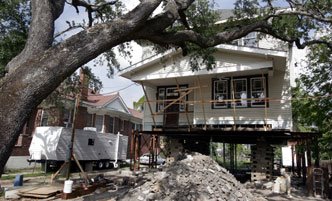
Unfortunately flood victims in south Louisiana are finding out that raising their homes is no day at the beach. Insurance companies are making it a cruncher and some may be headed for a wipe out.

Even before the storm, Fitzpatrick's Lakeview Drive house was shoulder-height off the ground.

To make it as resilient as possible against any future storms, Fitzpatrick is rebuilding with rebar and concrete pilings, and he is raising the house another two to three feet, as required by the new flood advisory maps from the Federal Emergency Management Agency to maintain flood insurance coverage. When he's done, the house will be eight to nine feet off the ground.

But Fitzpatrick is encountering opposition from an unlikely source: his insurance company. Allstate told him he's ineligible for homeowners insurance if he raises his home.

"I'm actually rebuilding higher than it was before, but now they're saying, 'We have a rule that if it's four feet above the ground, you've got to get the state plan, the Citizens plan, and it's always been that way,' " a dumbfounded Fitzpatrick said. "I said, 'Ya'll never had a problem with this before.' Of course the home has to be elevated: I'm trying to protect it from the storm surge."

In short, Fitzpatrick is trapped in a post-Katrina insurance conundrum that could affect thousands of people in south Louisiana if other insurance companies have rules similar to those at Allstate. Fitzpatrick is required to elevate his home to maintain flood insurance coverage, but if he elevates he won't be able to maintain a private homeowners insurance policy.

Allstate's excuse seems bogus to me.
Fitzpatrick said his Allstate agent told him that the rule started in 2000 because of concerns that if a house is too high off the ground, people might fall off of railings or try to barbecue under the house and catch the place on fire.
Current building codes require that decks/balcony's over 30" above grade be constructed with a minimum 42" high guardrail sufficient to resist at least 200 pounds lateral force. Besides, I don't believe homeowners insurance covers falls. I would imagine that is covered by ones' medical insurance.

Nonetheless, people in Lakeview are raising their homes and not bailing out. Awesome! My guess is that these people don't use dweebs for their insurance. Kowabunga!

Tuesday, February 06, 2007

How Slow Can You Go?

The Road Home Program keeps promising to speed the process up, but the results are still unimpressive.

BATON ROUGE — The Road Home program continues to struggle to unspool money in the $7.5-billion homeowner aid program.

With 105,739 applications received to date and 74,571 appointments scheduled or held, officials say they are primed to increase the payout pace.

Benefits have been calculated 34,779 homeowners, which means they can agree to accept the money being offered, but just 532 homeowners have done so, including just 141 in the past week of the 19-week program. That's an average of 28 homeowners being paid per week

At this rate it'll take approximately 314 years to dole out all the money. Maybe I'll enter my pet snail in the next marathon and see who finishes first.

Monday, January 29, 2007

Keeping Track


The Brookings Institution has been keeping track of the status of the recovery of New Orleans.

This months summary has been released with some somewhat positive stats.
Housing

• Housing construction continues to increase, indicated by the fact that new residential housing
permits exceeded pre-Katrina levels in both October and November for the first time since the storm.
• Home demolitions continue to trend upward: 649 additional homes were torn down over the last
month, bringing the total number of demolitions in the metropolitan area to over 4,200 houses.
• The number of residential properties for sale dropped slighted over the holidays, particularly in the
hurricane-affected parishes. This tightening of the market could signal strengthening of real estate prices.

Economy

• One more hotel reopened in New Orleans this past month. Now fully 90% of all hotels in the city are
back in business.
• Traffic at the Louis Armstrong International Airport continued to tick upward in October and
November as nearly 300,000 passengers both arrived and departed in each of those two months.
• Louisiana unemployment claims trended slightly upward in the last four weeks of 2006.
• Recently released figures for the first quarter of 2006 substantiate what is well known locally – that
average weekly wages have increased since the storm in many sectors. Average weekly wages have
jumped across almost all sectors including accommodations & food services, construction, educational
services, finance and insurance, utilities, and public administration. But wages have remained stagnant or
fallen in a few categories such as agriculture, and arts & entertainment.
Thats the good news. Now the bad:
Infrastructure

• Infrastructure recovery is largely at a standstill with only one new school opened in December, no new
hospitals, no new libraries, and only one new child-care center in New Orleans.
• The level of public transit service has remained unchanged for the last twelve months. Just 49% of all
public transportation routes and 17 percent of buses are in operation.
What can we conclude from this? By the looks of things, the private sector is out pacing the public sector. As for the ramifications, I'll leave that to the reader.

Friday, January 26, 2007

Thursday, January 18, 2007

Red Handed

John Blutarsky at The Third Battle of New Orleans relates the story of an architectural thief getting away with his crimes and names names.

Murder is one thing, but this is unaccetptable.

Monday, January 08, 2007

Constrained By Reality

Some are criticizing Hurricane Katrina victims for rebuilding their homes without raising their homes above potential flood waters.

After Katrina, teams of planners recommended that broad swaths of vulnerable neighborhoods be abandoned. Yet all areas of the city have at least some residents beginning to rebuild. With billions of dollars in federal relief for homeowners trickling in, more people are expected to follow.

Moreover, while new federal guidelines call for raising houses to reduce the damage of future floods, most returning homeowners do not have to comply or are finding ways around the costly requirement, according to city officials.

"It's terrifying: We're doing the same things we have in the past but expecting different results," said Robert G. Bea, a professor of civil engineering at the University of California at Berkeley and a former New Orleans resident who served as a member of the National Science Foundation panel that studied the city's levees.

"There are areas where it doesn't make any sense to rebuild -- they got 20 feet of water in Katrina," said Tom Murphy, a former Pittsburgh mayor who served on an Urban Land Institute panel for post-Katrina planning. "In those places, nature is talking to us, and we ought to be listening. I don't think we are."

But someone injects a little bit of reality into this debate.
Mike Centineo, the city's building chief, said, "Legally and morally, we're doing the right thing," but he acknowledged that most returning homeowners are not raising their houses to meet the new flood guidelines. "You wouldn't want to put people through more than they can endure. It's a catastrophe that happened. No one wants it to happen again. But they're just rebuilding as best they can."
People need to realize that we live in a world of constraints. Architects have to live with the force of gravity, building and zoning codes and pain-in-the-arse owners. All of which are hindrances to what we may actually want to do. Rebuilding a city is no different. Many have been critical of Mayor Ray Nagin for having a hands-off approach to the planning process. What they don't consider is that Mayor Nagin is a politician. And as such, he is limited in his power by the City Council who in turn are accountable to their constituents. Thus, none are prone to make decisions that will anger their voters. And telling some voters that they can't rebuild a home that they own is simply political suicide. Ergo, it won't happen.

So where do we go from here? Since most homes and businesses will not be built above the flood level, the government will have to provide the levee protection that we as taxpayers paid for already and are paying for again. For if the levees had been built properly, I wouldn't be doing the blog.

Friday, January 05, 2007

Swap Meet

An aide to Mayor Nagin is floating a trial balloon that program could be instituted that would allow people or groups of people can swap their property in blighted areas of the city with properties in non blighted areas.

One possibility, said Ed Blakely, the city's new recovery czar: Let the city assemble vacant or blighted properties and offer them in swaps to homeowners -- preferably groups of neighbors -- who want to move out of sparsely populated neighborhoods and be closer to schools, shopping centers or other vital areas, while staying near their friends.

"What I'm suggesting here is not wide-eyed radicalism. It's been done before," Blakely said. "It works."

One idea among many: using the city's public land bank, the New Orleans Redevelopment Authority, to allow neighbors along a nearly dead street to swap their properties for city-held lots in a more vital neighborhood of their own choosing.
I don't know how well this idea will go over with residents but at least it is a novel idea that avoids the heavy-hand of government compelling people to do or not do things they are unwilling to do.

The one hindrance the idea may face is that people have strong emotional ties to their neighborhoods. But, in many cases, it is because it is where their friends and family live. So this plan may not be totally without merit.

Ultimately the success or failure of this proposal will be determined by the residents of New Orleans, not some faceless bureaucrats in some far-away place. And that is how it should be.

Tuesday, December 19, 2006

Start Me Up

One mile of the St. Charles streetcar from Canal Street to Lee Circle is up and running today. Only five more miles to go.

Wednesday, December 06, 2006

The Road Home-less Program

Governor Kathleen Blanco's Road Home Program has been taking criticism from all directions due to the slooooowwww pace of distributing checks to flooded homeowners. Now, City Business has take up the task of tracking the rate of progress (or lack thereof) the the Road Home Program in making people whole.

Since last week, almost 2,000 homeowners have made their selections and mailed back their Benefit Option Letters to The Road Home. Since last week, almost 2,000 homeowners have made

However, just 56 of 85,256 applpicants have been paid. The average claim being paid totals $51,452.

Homeowners are marking their choices to stay in their homes, relocate to new homes in Louisiana or sell their homes and move out of state.

In November, The Road Home mailed more than 10,000 letters to homeowners, detailing their options and informing them of the award amounts for which they are eligible.

Upon receiving a homeowner’s letter, program officials are entering each homeowner’s response into the system and are compiling reports detailing the choices that homeowners are making. This information will be released as soon as it is available.

The Road Home is working to ensure that homeowners understand the content of their letters. Each homeowner who has received a letter will also receive a phone call from a program representative to answer any questions they may have about their awards or the closing process.

Some phone calls have already been made to applicants. Homeowners should carefully read the instructions contained within the letter when making their choice. Those homeowners with questions about their letters are encouraged to call The Road Home hotline at (888) ROAD-2-LA and choose prompt No. 6. Staffing at the call center is being increased on a daily basis to accommodate the expected influx of homeowner calls.

Since the program began sometime around early October, just 56 checks have been mailed. At that rate, all applicants should be made whole about 270 years from now. I understand that the wheels of government turn slowly, but this is ridiculous.

Wednesday, October 25, 2006

Teacher's Dirty Look

The Times-Picayune has been reading my blog.

As architect Michael O'Brien of Virginia Tech's Myers-Lawson School of Construction explains, economies of scale, standardization of design and assembly-line construction techniques were applied to high-volume home-building.

"In the 1950s and 1960s, slab-at-grade ranch-style construction in the city and along the low-lying Lakefront became the norm," said Richard Campanella, a geographer at Tulane University.

Suburban New Orleans, sunken though it was, broke with its past. It became a region dominated by slab-on-grade homes.

In the ensuing decades, local government, developers and eager home buyers sought to maintain the constantly shifting equilibrium that kept drainage improvements ahead of the spreading, slab-on-grade home-building.

Weather watch

It mostly worked. But there were spectacular, and increasingly frequent, exceptions.

Time would demonstrate that the inauguration of the slab-on-grade era coincided with a relative lull in extreme rainstorms. But three decades after the slab revolution began, intense spring cloudbursts of 10 inches and more in just a few hours, storms thought to be relatively rare, came with dismaying frequency: 1978, 1980, 1989 and 1995.

Now that we know the problems inherent in the slab-on-grade home, we now need to develop methods to make the raised home compete economically with the ranch house.

In my post I wrote: The popularity of the ranch house is due in part because of the cost savings involved by substituting materials cost for labor cost as a result of the changing labor market immediately after World War II. Rule of thumb is that labor cost is twice that of materials cost. When developers needed to build thousands of housing units in a short period of time and for families on a limited budget, the ranch house built on a concrete slab became the construction method of choice for many decades. The ranch style further grew in popularity as it became a symbol of middle-class upward mobility and the raised cottage came to symbolize the old neighborhood.

This is echoed by Michael O'Brien of Virginia Tech's Myers-Lawson School of Construction:

Levitt broke down the construction of a house into 26 industrial processes, right down to landscaping. He used just a few floor plans with few variations. His building crews moved from lot to lot, doing one thing at each site -- flooring, window installation, painting -- with ferocious efficiency. He effectively reversed the assembly line: The house stood still, the assembly line moved relentlessly past.

"What American industry learned in cranking out B-17's and Sherman tanks, they started to apply to housing," O'Brien said.

In four years beginning in 1947, Levitt produced 17,447 homes in his landmark Levittown. At its peak, O'Brien said, Levitt's teams finished 25 to 30 homes per day. Home builders around the country took note.

Moreover, a new consumer psychology was taking shape. The new ranch-style house -- the iconic "Red Rambler" model -- became the consumer ideal, the popular symbol of progress and status.

But the ranch soon exposed its soft underbelly.

(I)n time the homes would show their limitations, chiefly their limited size and, oddly in the earliest days, their lack of central air conditioning or other amenities like porches, high ceilings or big windows to deal with the New Orleans heat. The Maumuses started with an attic fan. They would add central air conditioning later.

The limitations existed because the houses had powerful national appeal across every region, O'Brien said. Especially in the early years, builders learning mass-production techniques tended to export successful models into new climates with little or no adaptation, he said.

"People were not thinking so critically when they took designs from one part of the country and moved them to another.

"In the Northeast, a house might not be too bad. But you put it in Florida and it might not be the best thing. But the history of housing is filled with those kinds of errors," he said.

The good news is that maybe people are beginning to take notice. The Southern Pine Council (Southern Pine is the type of wood most used in the Southeast United States) has launched a web site promoting the virtues of raised floor construction. The site is full of good information but what I think is lacking is inovative detailing that would reduce the extra cost of raised floor construction versus slab-on-grade.

Without the kind of outside-the-box thinking that is needed, builders should be sent to the Principal's office.

Tuesday, October 24, 2006

Carrot-n-Stick

The RAND Corp. has released a study which proposes that the rebuilding process should not concentrate on restoring things the way they used to be but rather improving and restructuring the infrastructure to have the Gulf Coast better weather the next catastraphe.

The politically volatile option of closing flood-prone areas to redevelopment might do more to reduce death and property loss than building bigger and better levees and floodgates, a new RAND Corp. study concluded. The study released Monday also warns public officials to plan now to avoid a repeat of the breakdowns in regional infrastructure and services, including a disruption of first-response and public safety networks, in the event of another Katrina-like storm hitting the Gulf Coast.

And it warns that as the community rebuilds, the "inherent bias towards creating what used to be" could blind residents and public officials to better rebuilding alternatives.

The wide-ranging 66-page report, which examined four flood disasters around the world in an effort to find lessons for New Orleans, contains both short- and long-term recommendations and examines both preparation for floods and rebuilding issues.

"In the short term, you've got to realize that someday this kind of disaster is going to come back," said James Kahan, one of the authors of the report and a senior behavioral scientist with RAND, the Washington, D.C., policy think tank. "It may happen next year or in two years or five or 10 years. But you've got to have the infrastructure to deal with it, even if it brings another tidal wave and the levees break again."

These are all good points and citizens need to see that their elected officials follow-though on their obligations. That said, one of the authors, James Kahan, points out the obvious that throws spanner in the works:

"Some activities, such as evacuation planning, simply cannot be implemented on the fly," the report said. Kahan said the most difficult decisions will concern where people rebuild in Katrina's aftermath.

"You've got to have a place for people to live or you can't encourage them to come back," he said. "But if you just put people in the same old flood plain, the next time a similar storm comes, you'll have the same problems all over again, and you don't want that.

"Maybe you don't want to encourage a return for everyone who wants to come back," he said. "It's not an automatic decision. Their protection has economic and environmental consequences, and I think there's 100 percent agreement that what happened last year is not to be tolerated."

He realizes that with private-property rights, the government cannot simply tell people where they can and can't live. What can be done is to offer incentives for people not to rebuild in flood-prone areas. Use the carrot, not the stick.

Release The Architects

The LRA has submitted it's application to FEMA's Alternative Housing Pilot Program which is intended "to identify and evaluate alternatives to and alternative forms of FEMA Disaster Housing."

No conclusions are reported in this press release but it is interesting to note some of the participants involved.

Katrina Cottages & Carpet Cottages - Cypress Cottage Partners
This partnership of The Cypress Group, The Shaw Group, ICF International, Duany Plater-Zyberk, and Lowes with architect Marianne Cusato showcases both single-family models and a multi-family model. This project includes infill redevelopment housing in New Orleans in the historic Treme neighborhood, as well as at Jackson Barracks, the headquarters of the Louisiana National Guard. Additional project sites are infill locations in Lake Charles and Abbeville - addressing diverse housing needs, particularly elderly housing for rural aging populations.


Home at Last - Family Resources of New Orleans
This non-profit community housing development organization identified two sites in rural St. Charles Parish that will serve as transitional housing communities for displaced residents of New Orleans. Working in partnership with Skyline Homes and Champion Homes, Family Resources presents a project that is transitional, while also working with modular housing developers to design an alternative solution to group trailer communities.


The Phoenix Systems-Built Home - Fibrebond Corporation
This company is an established, high production capacity firm that builds concrete panel building systems. After Hurricane Katrina, they were essential in adapting their building designs to produce and build many schools throughout the disaster-impacted area. Fibrebond has developed a model home that applies their building system and capacity to the housing market. This home represents an affordable, easily produced and built solution to the challenges of critical post-disaster housing.

SmartPlus® For A Better Built Home - Palm Harbor Homes
This manufacturing company has significant production capacity and designs that have the flexibility to be applicable Louisiana and nationwide. The models in this project represent a cost effective, attractive alternative to the trailer.


Homes Now LLP
This firm is based in Louisiana and partners with Genesis Homes, Inc. a division of Michigan based Champion Enterprises, Inc. Champion operates 36 manufacturing facilities in North America and the United Kingdom. Genesis has developed a series of off-site built homes specifically for the Southern Louisiana market. They can produce 250 homes per month or 2,880 homes per year.

CORE - Plus One
The "CORE" concept from Plus One, an architecture and construction services firm, represents an immediate emergency concept for transitional recovery housing. This CORE is a module of essential services (bathroom, kitchen, utilities) that can be appended to a home being rebuilt for a temporary period. The module can be stockpiled for reuse in the next disaster.

Once FEMA announces a decision, the state will work with the parish and municipal governments or applicable jurisdictions to determine sites, where needed, for the placement of the housing units in the most heavily impacted parishes. The LRA will set the overall housing policy and guidance for the transitioning of displaced citizens into livable homes.

More than 200,000 housing units in Louisiana suffered major or severe damage as a result of Hurricanes Katrina and Rita. Currently, there are over 85,000 occupied trailers in Louisiana and an estimated need of 96,000. Louisiana has the largest number of occupied trailers both individually and in group sites of any state impacted by the hurricanes of 2005.

Based on this list it appears that the direction that Louisiana is intended to pursue is for more permanent, modular housing be provided as opposed to the tin-cans we are so accustomed to. Also I like the fact that Marianne Cusato and Duany Plater-Zyberk are involved in in this project. From the beginning, they have demonstrated the ability to think outside the box while proposing designs that are architecturaly pleasing, but also popular with the general public.


Should FEMA adopt some of what the LRA is proposing, we may see in improvement in the appearnce, value and code compliance with these new homes as they will have some things much of the current housing stock does not: economically constructed and architect designed.

Thursday, October 19, 2006

(Your Home Has Lifted Me) Higher And Higher

Some people are not happy the local rebuilders are not doing so in accordance with federal regulations requiring that rebuilt home be raised three feet.

NEW ORLEANS — Nearly three-fourths of New Orleans homeowners applying for federal grants say they'll rebuild their Katrina-damaged homes in flood areas even though city restrictions are unlikely to prevent their houses from being wiped out if the levees fail again.

The restrictions, which say that the city's homes must be raised at least 3 feet to avoid flooding, have come under fire from some local officials and government watchdog groups. They say 3 feet of elevation is not needed in areas that did not flood after Hurricane Katrina, and 3 feet is too low in areas that saw 20 feet of water.

Even the Federal Emergency Management Agency says thousands of houses could flood again if they are rebuilt under the new rules. "If there is another catastrophic event, flooding will occur," says Doug Bellomo, a deputy director of risk analysis at FEMA.

The Louisiana Recovery Authority, which controls billions in federal relief money, expects about 53,000 New Orleans homeowners to apply for federal grants. The grants provide up to $150,000 for uninsured losses, and residents can use the money to rebuild or relocate.

So far, 14,534 New Orleanians have applied for grants; about 10,634 have said they want to rebuild where they were.

"The taxpayers are going to be subsidizing unwise construction," says Robert Hunter, director of insurance for the Consumer Federation of America. About $7.5 billion is available to homeowners.

The New Orleans City Council adopted the 3-foot rule on Sept. 1 to avoid losing millions in federal grants. The recovery authority has said parishes that don't adopt the rules will be excluded from receiving some of the relief money.

St. Bernard Parish, where all but 50 homes flooded, is considering rejecting the rules. "Our goal is not to adopt them," says St. Bernard Councilman Craig Taffaro. "We don't agree with the science."

Paul Rainwater of the recovery authority says the rules are "not perfect," but will help residents get much-needed flood insurance.

The second paragraph sums up the contradiction in the government's regulations. The second problem is that, while residents will get government grants to repair their homes, it does not include enough to cover the cost of raising it three feet.

It is possible to get a FEMA grant of up to $30,000 to rais a home. However, that amout is about what it costs to raise a house that is already raised on piers. If your home is a slab-on-grade (BTW is the type of house most likely to flood), the estimated cost to raise it could be as much as $100,000.

So when homeowners are contemplating taking out a loan for approximately $70,000 versus purchasing flood insurance, it may be that the premiums are lower for a non-raised house compared to the mortgage payment.

Rita Coolidge would be proud.

Monday, October 16, 2006

How I Hate Thee...

The LRA isn't too popular these days. Want to know how unpopular, just read this letter-to-the-editor.

Published: Oct 14, 2006

Are the media in Baton Rouge giving you any sense of how the people in the most-devastated areas feel about the Louisiana Recovery Authority? Hate is not too strong a word.

We hate the bureaucracy designed to siphon off money that people need to rebuild their lives.

We hate the unnecessary delays.

We hate Gov. Kathleen Blanco’s “covenant” that tells people in a free country where they have to live.

We hate elevation requirements enacted to make the Army Corps of Engineers’ job easier.

We hate the fact that this is ridiculously impractical even if they gave us the pittance they are offering for the work.

Where will we get the thousands of skilled workers to do this job? How long would someone have to wait?

We hate the fact that they know this, and still choose to place this burden on us.

The recovery authority’s Sean Reilly indicated that they would use the “money we control” to send a message that some areas should not be rebuilt.

We hate the fact that people who evacuated and now live and work out of state will still face financial ruin because we are worth less to Blanco since we won’t be around to vote for her.

We really do hate the LRA, and we’re trying not to hate the people who developed this plan. The whole tone of the plan is condescending.

This “covenant” business sounds like it was written by someone who lives in a restricted community.

The pain caused by government ineptness and corruption is second only to losing our loved ones.

It was actually LESS stressful to lose all our earthly possessions.

God help us, because the state of Louisiana sure isn’t.

Vicky Mocklin
librarian
St. Bernard resident now in Memphis

God help us all, indeed.

Monday, October 09, 2006

Lucky Number 13

Governor Blanco's Road Home program has handed out only thirteen checks out of an estimated 200,000 potential applicants.

At this rate all checks should be delivered by the time the next once-in-a-lifetime storm comes this way.