Thursday, September 07, 2006

My City Is Smarter Than Your City


New Orleans finally ranks high in something positive.

The brainiest cities in the United States
Top 25 cities with more than 250,000 population, ranked by percentage of bachelor's degrees among residents 25 and older
City State Percent
Seattle WA 52.7
San Francisco CA 50.1
Raleigh NC 50.1
Washington DC 45.3
Austin TX 44.1
Minneapolis MN 43.2
Atlanta GA 42.4
Boston MA 40.9
San Diego CA 40.4
Lexington-Fayette KY 39.5
Denver CO 39.0
Charlotte NC 38.8
Portland OR 38.8
St. Paul MN 36.5
San Jose CA 36.1
Colorado Springs CO 34.9
Honolulu HI 34.7
Oakland CA 33.8
Pittsburgh PA 32.3
New York NY 32.2
Albuquerque NM 32.2
Anchorage AK 32.2
Omaha NE 31.9
Nashville-Davidson TN 31.7
Columbus OH 31.4
New Orleans LA 31.4

Keeping On Top Of Things

The Times Picayune's website has an interactive map documenting the progress of reconstruction.

Kinfolk

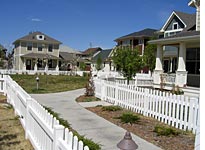
The Katrina Cottage now has a first cousin and its name is the NOLA Bungalow.

The 455-square-foot NOLA Bungalow is modular, which means its parts are made in a factory and assembled at its destination. The home is also reusable and does not use natural gas or propane as a heating source.
Let's hope that the Katrina Cottage and the NOLA Bungalow will come from a large family.

Wednesday, September 06, 2006

You Are Here

The National Trust for Historic Preservation has issued a report on the status of the rebuilding of New Orleans.

The Aug. 24 report says that citizens who return to New Orleans face problems like crime, inadequate city services, vacant buildings that attract vandals, and demolitions that degrade neighborhoods that are fighting to rebuild themselves.
Well I didn't need a report to tell me that. Though the article provides a link to the study which is a series of articles on the recovery effort that are listed below:
Rather that me provide a synopsis of the articles, read the whole thing.

Saturday, August 26, 2006

A View To A Mill

Tracage condominiums in the Warehouse District is scheduled to begin construction in about 45 days and already they are upsetting the neighboors.

Last week the City Council approved the condos slated for the intersection of John Churchill Chase and Annunciation streets. Opponents say the 24-story building, which falls outside the boundaries of the historic Warehouse District, will ruin the ambiance of a neighborhood consisting mostly of four- to five-story buildings.

Some residents of Lengsfield Lofts on Churchill are also concerned Tracage will block their views.

Joshua Rubenstein, a New Orleans attorney and resident of Lengsfield Lofts, a neighboring condo project, said he is strongly considering suing the city and Tracage.

"I don't think a building of that height is appropriate for the Warehouse District," said Rubenstein, who said the views from his Lengsfield Lofts condo will be totally obscured by Tracage.

My own opinion is that their concern about views and character are overblown. The site of the proposed building is currenly occupied by a couple of non-descript wharehouse buildings that have none of the character that most people associate with the Wharehouse District. And with regard to views, the site is adjacent to the elevated Ponchartrain Expressway and across the street from a recently constructed self-storage facility and no one is complaing about it. In fact, if I had my druthers, I think I would prefer to look at a shiny new tower than a windowless, block-built box of a building .

Also,since the developers are including retail spaces on the first floor, this will bring much needed amenities to this part of the city.

So contrary to its detractors, area residents should stop worrying and learn to love the tower.

Friday, August 25, 2006

Give Me That Old Time Modernism

The debate between New Urbanism and Modernism continues and Slate.com jumps into the ring again with this article about the new mixed use development on what used to be Stapleton (Denver) International Airport.

One of the largest new-urbanist developments under construction at the moment is in Denver. Stapleton is the site of the old Denver airport. When it's finished, the 4,700 acres will have 30,000 residents and 35,000 new jobs. The pragmatic developers—Forest City Enterprises—have provided something for everybody. In addition to dense residential neighborhoods of single-family houses, there are low-rise apartment buildings and condos, an 80-acre public park, several neighborhood centers, a regional shopping mall, an office campus, and a power center that includes a Wal-Mart and a Sam's Club. This is not doctrinaire new urbanism, but in the real world, planning doctrines must adjust.
The conclusion of the article is much the same as I've said in this blog that New Urbanism does not have to compete with Modernism. In fact, many areas in SE Louisiana can be both New Urbanist and Modernist. If only the Modernist will learn this lesson. The shortcoming (IMO) of the Modernists is they tend to focus soley on style whereas New Urbanist delve mainly into how cities function with respect to its residents. Disneyification is only an afterthought.

The second conclusion of this article, again, agrees with of many of my previous posts.
In July, the city put the rebuilding in the hands of the Greater New Orleans Foundation, a local charity. Abandoning the idea of a citywide visionary plan, the foundation will focus its reconstruction efforts at the neighborhood level. Whether or not this strategy will succeed—and in the current state of New Orleans, who knows?—it is not unreasonable. Levees and flood control infrastructure must be built by public agencies, but urban neighborhoods, as Jane Jacobs pointed out long ago, work best when created piecemeal by private households and entrepreneurs. So, a decentralized approach is definitely a good idea.
As I have posted before, the rebuilding of New Orleans should be driven by the residents and the planning process, slow as it may be, is going about it the right way. This city is almost 300 years old and it wont be rebuit in one.

Tuesday, August 08, 2006

Lords Of The Realm

The NY Times writes about the planning process going on in New Orleans and it reminds me why I don't usually read the Times.

Here are a few examples of the newspaper's inaccuracies:

Worst of all, by planning ad hoc, the city is forfeiting a chance to consider how infrastructure could be used to bind communities — rich and poor, black and white — into a collective whole. It allows residents to retreat back into their old ways and ignore uncomfortable social truths.
This paragraph assumes that New Orleans is racially segregated like so many northern cities that the Times writers are so used to. The fact of the matter is that most New Orleans neighborhoods are very much integrated. Although some neighborhoods have little integration such as the Lower Ninth Ward and Lakeview. Areas such as New Orleans East and Uptown have a varied mix of races.
Part of this mentality is related to the anti-big-government campaigns that gained momentum in the Reagan era, leaving ever more infrastructure, from parks to phone systems to schools, in the hands of private corporations. But the aversion to broad planning is also based on a neo-liberal belief that it is impossible to build any large-scale urban project without destroying the fine-grained fabric of city neighborhoods.
Anyone living in New Orleans for any amount of time will know that Reaganism largely passed us by. In fact, New Orleans is a liberal island in the middle of a conservative sea. Additionally, aversion to large federal government projects in the city goes back to the 1960 when the city's residents protested the construction of the Interstate Highway between the French Quarter and the Mississippi River. Such a project would have doomed the French Quarter. Instead the Interstate was relocated behind the French Quarter along North Claiborne Avenue. This was the second worst place to locate the highway for N. Claiborne was the center of a vibrant black middle neighborhood. For the record, during the 1960's, Ronald Reagan was the Governor of California.

This issue is discussed in a subsequent paragraph:
Mr. Kroloff, the dean of the Tulane University School of Architecture, has also raised the intriguing possibility of dismantling a portion of the freeway that now separates part of Tremé from the French Quarter, stitching the two neighborhoods back together and partly righting a wrong from the 1950’s, when the highway’s construction wiped away one of the city’s thriving black commercial strips.
Do NY Times editors read their own copy?
This idiosyncratic approach allows the government to circumvent the racial issues that torpedoed earlier planning proposals, in particular a legitimate suspicion among low-income black residents that any large-scale planning effort would be used to marginalize them.
Forget that Lakeview also protested the planning proposal for the same reasons.
Of course such progress is only possible in a world where government does not abdicate its responsibility to provide all of its citizens with a measure of protection. The Federal Emergency Management Agency packed up and left long ago. The federal government has yet to significantly raise the level of levee protection. Nor has it committed the money needed to rebuild the coastal wetlands and barrier islands that could absorb the impact of another storm.
OK. So the residents of SE Louisiana said "Good ridance" when FEMA pulled out. The Corps of Engineers is in the process of rebuilding and improving the levees as we speak, albiet behind schedule and Congress is currently debating bills that would guarantee Louisiana a greater portion of the offshore drilling revenue. By the way, it was big government liberal Democrats that most strongly opposed these bills.
As it stands now, the planning process is a cause for both hope and rage. It awakens us to the reality of what Americans are capable of and what our government is not.
So what is the point of the article's last paragraph? Does the Times lament the fact that individuals are taking leading role in rebuilding their communities without the aid of the government? Or is it that the government is not building our communities for us?

People's memory is long in viewing the government's record when it comes to providing housing for it's citizens and they rightly choose to rule their own abode rather live as a surf in a manor.

Where Have All The People Gone

The Times Picayune reports that the repopulation of New Orleans has slowed to a trickle.

The number of people who lived in the region before Hurricane Katrina and had come back as of June 30 rose by only 2,000, or less than two-tenths of a percentage point, compared with three months earlier, according to the data. If extrapolated, the figures suggest the metro area's population stood at less than 1.1 million at the end of June, compared with the region's pre-Katrina population of 1.5 million.

The estimates include 171,000 pre-Katrina New Orleanians who have returned to the city. Current estimates from city officials and others claim that a total 210,000 to 250,000 people are living in New Orleans, though they don't say how many of them were here before the storm and how many are workers who have come for the rebuilding.

I have my owne theory for this. We are currently between two rebuilding phases. The first phase involved people who have the wherewithall to rebuild with their own funds or insurance settlements. After almost a year, those who fall into this category should be about complete with their rebuilding efforts. The second phase will begin shortly as the money from the CDBG program will begin to be distributed.

Once the bulk of these funds start making their way into the construction pipeline, we should see s sharp uptick in the repopulation in about six months. Six months is the approximate time for a typical house to be renovated.

Monday, July 10, 2006

The Whole Is Less Than The Sum Of It's Parts

Seymour D. Fair at The Third Battle of New Orleans has a post about past urban renewal projects in St. Lewis an the potential impact if similar revitalization is attempted in New Orleans.

New Orleans, for the part, avoided most of the federally-funded urban renewal programs and this decision left New Orleans with most of it's historic neighborhoods and structures intact. It is possible and unfortunate however, that a similar "checkboard" pattern of development (mostly vacant lots populated with sporadic structures here and there) could be the post-KTMB outcome in the heavily flood-impacted areas of New Orleans such as Lakeview, Gentilly, and New Orleans East. Hopefully, this will be minimalized long term.
I agree.

The main difference between the urban renewal projects paid for by the federal government and the cookie-cutter McMansions so prevelant in places like Dallas and Atlanta is that the developers of McMansions know what they're doing. That is the advantage of the CDBG monies being given to the state instead of a federal government run revitalization program.

The two things I fear are;
  1. The state legislature and the Governor's LRA will use the grant money to pay-off politica allies (as safe bet to be sure).
  2. The rebuilding process, though locall driven, will become centralized and thus result in efficent yet unwanted neighborhoods.
Mayor Ray Nagin's proposal that the overall rebuilding plan be composed of a compilation of the various neighborhoods plans. Although he has hinted that some overall planning may take place. I hope what he means by that is that some modifications may take place to make the disparate plans mesh in a more satisfactory manner as opposed to the neighborhood plans being over-ridden by some anonymous planner in City Hall.

Monday, July 03, 2006

Potholes And Pans

The transportation infrastructure of New Orleans took a beating from Hurricane Katrina but the city is not yet down for the count. According to New Orleans CityBusiness, progress is being made.

Pothole proliferation is just one hallmark of Katrina’s destructive blow to New Orleans’ infrastructure.

Ten months after the storm, about 15 percent of the city’s traffic signals are dead or blink chaotically, making intersections dangerous.

Nine thousand missing or damaged traffic signs have drivers wondering whether to stop, yield or go.

At night, streetlights are still out in hard-hit areas such as the Lower Ninth Ward and other spots.

Traffic backs up on the Interstate 10 Twin Span whenever workers perform emergency maintenance on temporary repairs made after Katrina.

But officials say progress is being made in repairing Orleans Parish infrastructure.

Robert Mendoza, city Public Works director since mid-April, said 388 of 458 traffic signals, or just below 85 percent, are functioning, with the rest expected to be working by August.

In some cases, traffic signals are repaired but remain dark because Entergy has yet to supply electricity. Also, traffic signals pieced together with temporary repairs sometimes break when it rains, he said.

Mendoza said Entergy estimates 90 percent of repaired streetlights are functioning. As of April, 42 percent of 4,327 damaged lights had been repaired at a cost of $494,733, he said. The $2 million in streetlight repairs should be complete in December, he said.
But this is not just a repair effort:
The need to bring older intersections up to current codes complicates the rebuilding by forcing the redesign of entire intersections, he said.
New Orleans has its fair share of bad intersections. Hopefully this will bring the streets into the 20th Century.