Showing posts with label planning. Show all posts

Tuesday, April 10, 2007

A Former Carpetbaggers View

Tom Bethell has penned an article in The American magazine about the progress of rebuilding in New Orleans a former resident. Rather than comment on it, I prefer to highlight certain passages that I think are to the point of our current rebuilding process.

On employment:

On the subject of New Orleans, [Tommy Lemann] was cautious and judicious, sometimes insisting that he not be quoted. There’s a labor shortage, he said, and this is possibly the city’s most serious problem. Many positions are unfilled, and shop windows all over the city have “Help Wanted” signs. New workers need housing, but there is also a housing shortage. To get housing, you need a job. So which comes first, the chicken or the egg? I was to hear others mention the same apparent conundrum.

Activity at the Port of New Orleans is back up to pre-Katrina levels, and law firms “are doing pretty well from what I hear,” Tommy Lemann said. “So much business is coming out of Katrina.” Tulane University had a lot of damage, and freshman enrollment fell. But it has been sustained at the professional schools. According to the indispensable Katrina Index, published by Brookings, Tulane started the 2006–07 school year with four-fifths the number of students it had before Katrina. “It would be adverse if we couldn’t get the young professionals to stay,” he said.

Americans got a televised taste of that culture at the convention center after the storm. As some Orleanians pointed out, the scenes were probably not so different from those that prevail on any other day—minus the dreadful shortage of food and water—in the worst parts of the city’s housing projects. Katrina drove many of the poor to cities (possibly as many as 100,000 to Houston ) with a stronger work ethic and a different attitude toward welfare. In October, the Bureau of Labor Statistics, in its final post-Katrina report, said that the unemployment rate among displaced evacuees was 17.9 percent, down from 34.7 percent in March; by contrast, the rate among return evacuees had actually risen, from 5.3 percent to 7 percent.

What no one says in public, but is widely conceded in private, is that, while tragic in many ways, the storm’s displacement of families may, in fact, encourage greater independence and better lives for the refugees. In New Orleans, many of them had become inured to state support and its perverse incentives.

On housing:

I had already read plenty about the flooding of the Lower Ninth Ward, in the part of the city east of the French Quarter, so I wondered if he could recommend some other, less advertised destination in the Tour of Ruin that is on every visiting journalist’s itinerary. Tommy Lemann suggested Metairie Club Gardens, “the most affluent flooded area of town.” Submerged under five feet of water, it is the only place where he has seen abandoned mansions. The owners in some cases are up in years, and don’t want to rebuild, he said, or they have no mortgages and are rich enough to move elsewhere. Or they worry that the area will flood again.
On population:

The population of the city, about 450,000 pre-Katrina, is now estimated at around 200,000. New Orleans may now be the second-largest city in Louisiana (Baton Rouge is probably first). The labor force in the New Orleans metropolitan area, which also includes suburban Jefferson Parish, has dropped from 640,000 before Katrina to 438,000 last October, according to Brookings. In the latest U.S. Census estimate, Louisiana had lost five percent of its population, a quarter-million people, mostly to Texas and Georgia.

New Orleans probably has a smaller population today than it had in 1880, when, with 216,000 people, it was the tenth-largest city in the United States, just behind San Francisco and ahead of Cleveland and Detroit. An article in The Times-Picayune—a transformed newspaper since the 1970s, with copious and excellent post-Katrina coverage—reported before Christmas that 84,000 residents have moved to Atlanta. Many went by car (unlike Houston, to which refugees were herded in buses), and “significant numbers” are doing well. “They consider themselves Georgians and say so.” It seems likely that many will not return.

The racial composition of the city has changed since the storm. Because black areas suffered more destruction and because many blacks lacked the means to resettle in New Orleans after Katrina, the African-American share of the population of the city, according to a survey commissioned by state agencies last summer, has fallen from 67 percent to about 46 percent. By income, Orleans Parish, which is contiguous with the city, was the eighth-poorest county in America before the storm, and New Orleans over the years has maintained an entrenched culture of poverty and entitlement, epitomized by its vast public-housing projects.

On commerce:

Next, I contacted Jeannette Hardy, a veteran journalist who, years ago, was the editor of The Courier, the alternative weekly where I published my first articles. Ginny later became editor of New Orleans, the city magazine, and then joined The Times-Picayune. She drove me uptown to a coffee shop on Magazine Street. Between the Mississippi and St. Charles Avenue, Magazine Street is well located, and it is thriving. The neighborhood is a swath of cafés, bakeries, restaurants, antique stores, and clothing boutiques that runs five miles. Lately called the “isle of denial” because it was so little affected by Katrina (though it suffered serious wind damage), the area is likely to be central to the city’s recovery in the years ahead.

“This town is traumatized and everyone in it, including me,” Hardy said as we sat down to coffee. Katrina’s aftermath was “so much bigger than one poor little city can deal with—a poor, divided city with different cultural values.” People are paying mortgages on houses that don’t exist anymore for fear of ruining their credit ratings, she said. “New Orleans needs Washington. We need a Marshall Plan. We did it for Germany. Why not New Orleans?”

On "the Mexicans":

Hardy’s roofer moved his whole family to the city, she said, and electricians, plumbers, and painters are doing well. “A new class of entrepreneurs in the building trade is making a great contribution.” She admires the Hispanics who have come pouring in. In December, newspapers reported an immigrant “baby boom,” almost all Latino. Two healthcare units that saw over 1,200 pregnant women in 2006 said that virtually all were Hispanic. “Before the storm, only 2 percent were Hispanic,” the head nurse in Metairie said. “Now about 96 percent are.”

According to the Louisiana health and population Survey, the number of Latinos living in households in Orleans and Jefferson Parishes has increased by about 20 percent since 2004, even as the total population of the two parishes has fallen by 25 percent.

On restaurants:
Although tourism has lagged, conventions are beginning to return, and, according to the Brookings study, 89 percent of the hotels have reopened, as well as nearly all the well-known restaurants, such as Galatoire’s, Antoine’s, and Brennan’s, and the best relative newcomers, such as Emeril’s and Herbsaint. A friend was in town shortly after the gala reopening of Galatoire’s on New Year’s Day 2006 and said it was the same as ever, with local socialites and artists spending entire Friday afternoons drinking Myer’s Rum and soda and dining on trout amandine and oysters en brochette. Antoine’s, the most famous restaurant in the city, which opened in 1840, reopened just four months after Katrina. Since then, however, it has lost about $5,000 a day, according to a report in The Chicago Tribune. Commander’s Palace, in the Garden District, did not reopen until November, more than a year after the hurricane.
On Nagin:
The mayor of New Orleans, C. Ray Nagin, concluded that he could not prevent people from spending their own money to rebuild their own homes—probably a wise judgment, politically and economically, although The Washington Post has criticized the “helter-skelter return of residents.” Likewise, The New York Times reported in August that City Hall “has settled back into its habitual easygoing rhythms; a well-placed insider there reported, with alarm, no sense of urgency among its officials.” But was inactivity so alarming? The good news is that it indicated that nothing too authoritarian was in the works.
On Couhig:

The leading Republican candidate in the mayor’s race was Rob Couhig, a lawyer with offices not far from the Superdome and City Hall. He came in fourth and threw his support to Nagin in the final round, declaring that the Landrieu clan had failed the city. One morning, I went to see Couhig, who told me that his office building at 1100 Poydras—just down the street from Mother’s Restaurant, famous for its Ferdi poor boy sandwiches—is full, and his firm is looking for more space.

About $25 billion in federal money will be spent in New Orleans in the next five years, he said. “The money is already in place.” He thinks that the fortunes of the city will depend more on the port, the universities, and a revival of the medical community (now much reduced) than on tourism.

“Our biggest need today is people,” he said. “We need fifty thousand people. There are employment opportunities for everyone from accountants to zookeepers.” But he is concerned that the powers-that-be have misdirected their talent search. Governor Blanco, for example, in a recent session of the state legislature, allocated hundreds of millions of dollars of state funds to attract a new German-owned steel mill with 3,000 jobs.

“But we don’t need jobs; we need people,” Couhig said.

On education:

I came away from the two schools impressed at the turnaround. Katrina has put one of the nation’s most retrograde school systems in the vanguard of reform. Currently, a significant majority of New Orleans public schools are charters, and that condition—different from any other large district in America—is likely to continue. A recent report estimates that 31 charter schools, enrolling 16,000 students, will be operating in the 2007–08 academic year, compared with 17 conventional public schools, enrolling 9,000 students.

As to whether charter schools can make a permanent difference, it is too early to say. Many of the students come from backgrounds that are hostile to learning. Can a relaxation of bureaucratic rules and the introduction of competition overcome that disadvantage?

Summary:

The question is whether the aftermath of Katrina—filled with both bureaucratic foul-ups and individual enthusiasm, hard work, and perseverance—has at last dispelled the inculcated passivity and victimhood that have been especially strong in New Orleans.

Looking back, I was reminded of something that Tripp Friedler had said. A familiar metaphor occurred to him as we spoke, and he applied it to New Orleans. It’s the story of the frog dropped into water that is being heated slowly. It doesn’t notice, fails to react, and dies. Turn the heat up suddenly, however, and the frog jumps out. In New Orleans, the deterioration has been going on for decades, and, on the whole, the city’s leadership, too absorbed both by Mardi Gras balls and racial politics, refused to acknowledge it. Then came Katrina, abruptly turning up the heat.

A change for the better could no longer be avoided. My impression, after a week in the city, is that it has begun.

Monday, February 19, 2007

It's Not The Size That Matters...

Its what you do with it.

Slowly, old American cities that have been in a downward population spiral for a half-century or more are reinventing themselves as, well, smaller cities. They're starting to adopt — many, like Richmond, do it unknowingly — tenets of the burgeoning, European-born "Shrinking Cities" movement. The idea: If cities can grow in a smart way, they can also shrink smartly.

"Everybody's talking about smart growth, but nobody is talking about smart decline," says Terry Schwarz, senior planner at Kent State University's Urban Design Center of Northeast Ohio. The center runs the Shrinking Cities Institute in Cleveland, a city that has lost more than half its population since 1950. "There's nothing that says that a city that has fewer people in it has to be a bad place."

New Orleans has been in a steady population decline for the past 30 plus years. This decline was instantaneously accelerated on August 29, 2005. Hopefully, Katrina will also speed up the process planning for the decline as others cities have done. Now that everyone is in agreement of what has happened, we need to look forward and decide on where we go from hear. Others cities offer insight into how this can be not only managed, but can improve the city.

It's a startling admission in a nation that has always equated growth with success. Cities are downsizing by returning abandoned neighborhoods to nature and pulling the plug on expensive services to unpopulated areas. Some have stopped pumping water, running sewer lines and repaving roads in depopulated neighborhoods. They're turning decimated areas into parks, wildlife refuges or bike trails. They're tearing down homes no one is living in and concentrating development where people want to move.

Richmond's acclaimed Neighborhoods in Bloom program targets six areas. Public funds are pouring in and private money has started to follow. The city wants to grow, but it's not waiting for a population boom, says Greg Wingfield, president and CEO of Greater Richmond Partnership Inc., an economic development marketing group. "We don't as a region aspire to be the next Atlanta or the next Charlotte," he says. "It's about quality. It's not about growing for the sake of growing."

As I've stated in an earlier post, the City of New Orleans needs to look into unincorporating the city east of the Industrial Canal (with the exception of the Lower Ninth Ward and Holy Cross) among other things.

  1. New Orleans should simply unincorporate most or all of New Orleans East. Bayou Sauvage Wildlife Refuge has no business being inside the city limits. Those living in New Orleans East will not like being unincorporated at first, but it simply means that the parish will take over those services that the city currently provide. In other words, be more like Jefferson Parish.
  2. If you want to convert neighborhoods back to wetland, don't be impatient about deciding where they should be. Recovery will be long term so let's plan long term. City officials certainly can wait to see which area make a substantial recovery. We may find some areas with few residents. If those residents decide they don't like living in "ghosts towns", the government coud offer to buy them out. Homeowners might be happy with this arrangement. If the government tried to force people out of their homes, they will be asking for nothing but trouble.
  3. Some City Council members will not take kindly to having their district being eliminated and will likely put up a fight to maintain the status quo. A city-parish form of government might be a good comprise to get some council members on board.
This approach might be described as "slash-and-burn" but the reality is that if a city is to shrink, it needs to shrink. Fortunately, other cities have managed this in a softer manner.

"European cities are grappling with how you deal with shrinking cities more forthrightly than we are," says John Accordino, urban and regional planning professor at Virginia Commonwealth University here. "(U.S. cities) are still trying to figure out how do we get our piece of the metro growth."

Youngstown, Ohio, is an exception. It has fully embraced its shrinkage. The population, now about 83,000, is less than half what it was when the steel industry collapsed in the 1970s.

"You look at the facts and come up with solutions," chief planner Anthony Kobak says. "The first step the city has come to terms with is being a small city."

Youngstown approved a 2010 plan. The goal: "A safe, clean, enjoyable, sustainable, attractive city," Kobak says.

The city long was better known for gritty steel mills than green space. Now that the mills are gone, there is plenty of space. With the help of a grant, Youngstown preserved 260 acres. It's targeting neighborhoods and redesigning them with the help of residents who stayed.

The city may let homeowners buy abandoned lots next door to create gardens. It's considering relaxing zoning rules to allow small horse farms or apple orchards. It's offering incentives for people to move out of abandoned areas.

"If you had three or four square blocks that at one time had 40 homes per block and now have maybe five homes total, we could relocate those people across the street and convert the vacant area into a large city park," Kobak says.Residents would live be living across from a park rather than being surrounded by decrepit homes and lots overgrown with weeds.

"If we're looking to preserve an area for green space, we may offer that person relocation money rather than rehab money," Kobak says.

Other cities may be less enthusiastic about shrinking but they're adjusting, nevertheless:

• St. Louis is reviewing abandoned commercial areas to determine if they're still needed. "We had a lot more people here," says Rollin Stanley, director of St. Louis' planning and urban design agency. "We had a lot more need for commercial strips. That need isn't here today."

The historic Gaslight Square area once teemed with nightclubs, theaters, bistros and art galleries. It was abandoned for more than 20 years. The city recently converted some parts to row houses and single-family homes.

"We have to rethink where we house people," Stanley says.Converting declining commercial areas to trendy residential housing has helped. Family incomes citywide increased 13.7% from 2004 to 2005, he says."We're rethinking land use allocation to meet the needs of the population we're going to see," he says. We're not shrinking. We're rethinking."

• Detroit spreads across 139 square miles and has almost a million fewer people than it did in 1950. Until now, revitalization efforts have focused on the 3-square-mile downtown.

This month, Mayor Kwame Kilpatrick announced an initiative in partnership with philanthropies, business, civic leaders and faith-based organizations that will target six neighborhoods that make up less than 10% of the city. "Some neighborhoods don't need to be addressed right away," says Matt Allen, the mayor's press secretary.

In February, the city will focus on parks and recreational facilities, most of them developed from 1920 to 1958, when the city boomed. When people left, many facilities were barely used. "People don't walk five miles to go swim in an 80-year-old pool," Allen says. "It costs a heck of a lot of money to run an 80-year-old boiler."

The city already has closed 14 recreational facilities and built state-of-the-art centers in the northeast, where there is the highest concentration of families with children, and in the southwest, where the Hispanic population exploded.

So far, city leaders have refused to address this issue. It may be that they are reluctant to move forward on this this issue due to the uncertaincy of the rate of repopulation. It's hard to plan for the future when you don't have any idea of what the future will be. Much of the cause of that is due to lack of leadership in Baton Rouge where the Governor Kathleen Blanco Road Home Program is handing out checks like molases in January and no one wants to address the insurance crisis.

However, others have addressed this issue and hopefully a public dialog can begin soon. With or without the politicians.

Wednesday, January 31, 2007

Unified New Orlean$ Plan

The Unified New Orleans Plan has been released to the public. The Times-Picayune give some background information.

Architects of the Unified New Orleans Plan said Tuesday that their agenda for citywide recovery will cost $14 billion during the next decade, requiring large infusions of government and private money to pay for homeowner incentives, major infrastructure repairs and economic development projects.

"At the end of the day, we're going to have a much better city than we had pre-Katrina, should this plan be implemented," said Troy Henry, a coordinator of the citywide planning effort, the outgrowth of months of public hearings.

It remains to be seen how city leaders, who are giving tentative backing to the unified plan, will fare as they try to persuade Congress, foundations and private investors to put money into the varied rebuilding ideas. Some of the $14 billion -- the exact amount isn't known -- is already available to the city through storm recovery programs, such as the FEMA program that pays to repair or replace public infrastructure damaged by the disaster.

Core features of the broad plan include incentive grant programs that would help city residents elevate their homes, rebuild slab homes using more traditional building styles and help residents relocate from flood-prone, mostly abandoned neighborhoods to more viable ones on higher ground. Those programs alone would cost more than $4 billion in coming years and would supplement any grants already available through the state's Road Home program.

Among dozens of other projects, the plan calls for spending more than $800 million to renovate or build schools and nearly $10 million to add a network of police substations. It also says $2.2 billion should be spent during the next decade on "ongoing replacement of all major and minor city streets."

In its budgetary scale, the recovery plan nearly doubles the amount of federal grant money reserved for the Road Home program, much-criticized because of processing delays.

What is striking about the basics of this plan is practicality of its proposals.

  1. Initiatives for people to raise their homes. ($1.2 billion over five years)
  2. Repair, renovate and rebuild schools. ($831 million over five years)
  3. Rehab and rebuild 5.000 low-income housing units. ($650 million over five years)
  4. Develop network of police stations. ($9.7 million over five years)
  5. Streamline blighted housing and "lot next door" programs. ($1.1 million over five years)
That adds up to $14 billion my friends. That means, in order to make this happen, additional grants from the Congress will be needed. And this does not count the money needed to implement the individual neighborhood plans which promise to be more of the things we expect from city planning such as bicycle/walking paths (sidewalks), parks, neighborhoods schools, more street lighting, zoning modifications and improved infrastructure. None of these plans involve anything that can be superfluous or trivial. Most of them involve infrastructure and services that taxpayers pay for anyway.

But what is striking about this plan is the lack of grandiosity of other plans. This is what will make the plan much more feasible. Lets hope so.

Monday, January 29, 2007

Planning Status

Mayor Ray Nagin comments on the status of the Unified New Orleans Plan. Click on the link to listen in.

Monday, January 22, 2007

Your Heart Says Yes, Yes, Yes. But Your Mind Says No, No, No.

New Orleanians seem to be in favor of the Unified N.O. Plan but have reservations about how to implement it.

The responses that audience members provided by way of computerized keypads suggested that most have little faith in traditional government bureaucracies' ability to carry out the behemoth task of rebuilding.

For instance, residents were asked whether the final UNOP plan ought to give high priority to creating a program of voluntary incentives to encourage residents to live near one another, along with a separate program to strengthen enforcement of blighted-property laws.

Though they generally supported the ideas, the residents also questioned the "integrity of the political process" needed to bring the plans to fruition and noted that the city did not have a good system to eradicate blight before Hurricane Katrina.

"There's billions of dollars coming into this city, and there's nobody to hold them accountable. We need to hold them to the fire," said Robert Dees, whose Algiers home was ruined by Katrina's winds. "On paper, everything looks good, but what about implementing it? And what about accountability?"

Given the atrocious track record of the LRA's Road Home Program, people down here are rightfully skeptical of local and state government implementing any kind of plan. Maybe this is a wake-up call for residents finally take control of their state and city and put people in charge who will do something about their community and not their cronies.

Friday, November 17, 2006

Sore Thumb

A politician once said that all politics is local. The same is true for good architecture. The redevelopment of the Jefferson Plaza Shopping Center is a good example of this axiom.

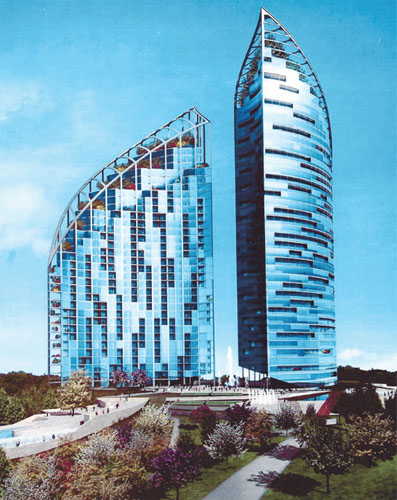
Conceptual renderings show a pair of curved glass-and-steel towers rising to points, with trees growing on rooftop terraces, fountains and pools on the grounds and intense lighting at the base of the structures, tapering toward the peaks. One tower might exceed 30 stories, far taller than any building for miles.

"It's going to be real dramatic lighting, along with dramatic water features," St. Raymond said.

The idea, however, is not receiving an entirely enthusiastic welcome in the neighborhood. Some nearby residents protest that it will exacerbate traffic problems, overshadow their houses and stick out, rather than stand out, among Old Jefferson's post-World War II wood frame houses.

So why is this design so unpopular? Seymour D. Fair offers his thoughts:
Architect Daniel Libeskind's above design was not what I had in mind--and I am not completely against multiple floored residential buildings at this site unlike many residents of the surrounding neighborhoods.
Daniel Libeskind is a great architect with soaring ideas for his designs, however like most starchitects, he is not in tune with the local vernacular and traditions. It is likely that the architectural firm was given a survey of the site along with some photos. With this information in hand, the design process begins. The architect may be able to come up with a design that will get noticed. But that is not always a good think. Severe birth defects get noticed too but no one wants one.

The developer and local residents would have been better served had a local architect been retained for the design. Perhaps the local architect's design wouldn't have been as radical but it probably would have been more contextual meaning more sensitive to the local environment and residents. This can't be done from a corner office in Manhattan.

Thursday, October 12, 2006

News To Me

Carnegie Mellon University recently (Oct. 9) held a series of lectures where one subject was New Orleans' Master Plan. Though many pixels have been used informing the public of the ongoing process of re-planning flooded and devestated areas of New Orleans but a master plan for the French Quarter is news to me.

Title: Stepping up to the Scaffold: Post-Katrina Planning on the Gulf Coast The basics: Architects Andres Duany and Elizabeth Plater-Zyberk, leaders of the firm Duany Plater-Zyberk & Company, will speak about their involvement in post-Hurricane Katrina rebuilding efforts in Mississippi and Louisiana. The team is one of the leading proponents of New Urbanism, an urban design movement dedicated to the promotion of healthy alternatives to suburban sprawl, and was recently awarded the master-planning contract for the French Quarter in New Orleans. When: 6:30 p.m. today Where: Carnegie Library Lecture Hall.
No transcript is available as far as I know nor could any information on the French Quarter master plan be found.

Monday, September 25, 2006

Oh Rebuild Me A Home, Where The Walkers Can Roam

The district rebuilding plans have been released and can be viewed via the links below:

I haven't been able to fully digest the impact the plans will have on the city as a whole but I can make a few observations.

First of all, the changes to the city scape are not as dramatic as I would have hoped which makes all the more likely that the rebuilding will happen. The recovery plans mostly focus on the restoration and improvement of the damaged infrastructure. That should be a no-brainer. However what is important is that different utilities and infrastructure are given different priorities reflecting their importance to the residents.

Second, one thing that did stand out is that a district's priorities were somewhat consistant with that of other districts with similar income levels. Fore example. The more affluent districts tended to want less parks and more green space along boulevards, mixed-use commercial developments and better streets and sidewalks. The middle-class neighborhoods are looking for some of the same improvements as the affluent areas in addition to pedestrian and bicycle paths whereas the poorer areas tend to concentrate on parks, neighborhood grocery stores and pharmacies as well as improved mass transit and sometimes an expanded street car line.

What is positive about these plans is that they reflect the priorities of the residents and not the dreams of some far-off planners. In addition, these plans are not entirely inconsistent with the city master plan commissioned by the BNOB last fall and was widely criticized.

The next step will be for the various district plans to be coordinated into an overall master plan for the city. Some might say that the earlier master plan was a waste of time and money. Not necessarily. The plan unveiled by the BNOB can serve as a guidepost for integrating the disparate plans into a single cohesive plan that everyone can be happy with.

Tuesday, August 08, 2006

Lords Of The Realm

The NY Times writes about the planning process going on in New Orleans and it reminds me why I don't usually read the Times.

Here are a few examples of the newspaper's inaccuracies:

Worst of all, by planning ad hoc, the city is forfeiting a chance to consider how infrastructure could be used to bind communities — rich and poor, black and white — into a collective whole. It allows residents to retreat back into their old ways and ignore uncomfortable social truths.
This paragraph assumes that New Orleans is racially segregated like so many northern cities that the Times writers are so used to. The fact of the matter is that most New Orleans neighborhoods are very much integrated. Although some neighborhoods have little integration such as the Lower Ninth Ward and Lakeview. Areas such as New Orleans East and Uptown have a varied mix of races.
Part of this mentality is related to the anti-big-government campaigns that gained momentum in the Reagan era, leaving ever more infrastructure, from parks to phone systems to schools, in the hands of private corporations. But the aversion to broad planning is also based on a neo-liberal belief that it is impossible to build any large-scale urban project without destroying the fine-grained fabric of city neighborhoods.
Anyone living in New Orleans for any amount of time will know that Reaganism largely passed us by. In fact, New Orleans is a liberal island in the middle of a conservative sea. Additionally, aversion to large federal government projects in the city goes back to the 1960 when the city's residents protested the construction of the Interstate Highway between the French Quarter and the Mississippi River. Such a project would have doomed the French Quarter. Instead the Interstate was relocated behind the French Quarter along North Claiborne Avenue. This was the second worst place to locate the highway for N. Claiborne was the center of a vibrant black middle neighborhood. For the record, during the 1960's, Ronald Reagan was the Governor of California.

This issue is discussed in a subsequent paragraph:
Mr. Kroloff, the dean of the Tulane University School of Architecture, has also raised the intriguing possibility of dismantling a portion of the freeway that now separates part of Tremé from the French Quarter, stitching the two neighborhoods back together and partly righting a wrong from the 1950’s, when the highway’s construction wiped away one of the city’s thriving black commercial strips.
Do NY Times editors read their own copy?
This idiosyncratic approach allows the government to circumvent the racial issues that torpedoed earlier planning proposals, in particular a legitimate suspicion among low-income black residents that any large-scale planning effort would be used to marginalize them.
Forget that Lakeview also protested the planning proposal for the same reasons.
Of course such progress is only possible in a world where government does not abdicate its responsibility to provide all of its citizens with a measure of protection. The Federal Emergency Management Agency packed up and left long ago. The federal government has yet to significantly raise the level of levee protection. Nor has it committed the money needed to rebuild the coastal wetlands and barrier islands that could absorb the impact of another storm.
OK. So the residents of SE Louisiana said "Good ridance" when FEMA pulled out. The Corps of Engineers is in the process of rebuilding and improving the levees as we speak, albiet behind schedule and Congress is currently debating bills that would guarantee Louisiana a greater portion of the offshore drilling revenue. By the way, it was big government liberal Democrats that most strongly opposed these bills.
As it stands now, the planning process is a cause for both hope and rage. It awakens us to the reality of what Americans are capable of and what our government is not.
So what is the point of the article's last paragraph? Does the Times lament the fact that individuals are taking leading role in rebuilding their communities without the aid of the government? Or is it that the government is not building our communities for us?

People's memory is long in viewing the government's record when it comes to providing housing for it's citizens and they rightly choose to rule their own abode rather live as a surf in a manor.

Wednesday, June 14, 2006

Mr. Roger's Neighborhood

Hattiesburg American.

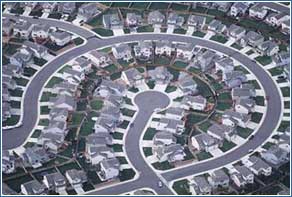
Most new housing developments today are not neighborhoods; they are simply a collection of storage buildings for people. In the typical American routine, you leave the house in the morning, drive miles and miles to work, chauffer kids to far-away schools or daycare then to farther-away recreational activities. In the evening, after spending much of your day in the car, you go back home, click the garage door up, and all the while you never come in contact with your neighbors.

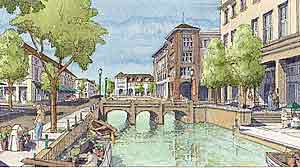
Think of a village when you think of a healthy neighborhood. A neighborhood is a place where you can choose to walk to work or stroll down to the grocery store or library or coffee shop. In a neighborhood, children walk to school and back home, freeing up parents' time and resources while offering the child a sense of independence. Safety is inherently built in because you know your neighbors and there are friendly eyes and ears on the street.

I think Mr. Polk is correct in his definition of a neighborhood but what is missing in his analysis is why urban sprawl so common these days. If one wishes to recreate that old time neighborhood atmosphere, one must ask why people are moving out of the cities in the first place.

My own opinion is that urban sprawl is simply a population's reaction to the misguided policies of utopians and public policy wonks. People began to move out of the cities and into new developments in the suburbs. The problem with this scenario is that developers can build streets, provide utilites and construct houses, they can't create schools, mass transit, and develop zoning regulations to ensure that commercial properties be located in close proximity to residential. What we ended up with is mass residential pods with little or no support mechanisms to foster the close knit atmosphere so desired by the New Urbanists.

What we have here is a failure to govern.

If we are to bring back the neighborhood, we need to look not at building cottages and picket fences with sidewalks. We need to look at public policy so that the right environment is created whereby the desired neighborhoods are a byproduct. After all, neighborhoods described by Mr. Polk are not built like Walt Disney Word's Main Street but evolve over time as a response to the environment.

Wednesday, May 03, 2006

Follow Me, You Go First

The Wal Street Journal online has an article about Andres Duany and DPZ's Gentilly charette. The writer mostly covers matters already hashed out in the media about the role of New Urbanism but later there is a paragraph concerning the rift between the New Urbanists and Modernists.

"Architecture in which the answers to the future only live in the past represents a limited world view," says Reed Kroloff, dean of the school of architecture at Tulane University. As part of Mayor Ray Nagin's Bring New Orleans Back Commission, Mr. Kroloff objected to Mr. Duany's participation in New Orleans. "We've got great planners here," says Mr. Kroloff, who is no longer associated with the city's rebuilding efforts. "We don't need an out-of-town firm."

While agreeing with the New Urbanists on several planning concepts -- mixed-use development, higher density and walkability among them -- Mr. Kroloff argues that the redevelopment of New Orleans must be guided by more contemporary planning. For instance, he objects to the New Urbanists' fondness for town squares, arguing that public green space should follow the natural pattern of the landscape.

Mr. Kroloff is doing here what he as always been doing, critisizing the work of other architects and planners while actually doing little or no work himself. Notice how Mr. Kroloff says in broad terms what needs to be done but offers no specifics. At least Mr. Duany is showing residents what the possibilities are for their rebuilt neighborhoods.

This response from one resident sums it up nicely.

"I don't give a flip what you call it," says Nikki Najiola, a member of the civic-improvement group who applauded Mr. Duany's concepts for Gentilly. "Just get me back into my house."

Monday, May 01, 2006

Echo Chamber vs. Retail Architecture


Two interesting articles this weekend put the different camps of rebuilding New Orleans in stark relief. The Christian Science Monitor covers DPZ's charette in Gentilly last week and the Washington Post writes about a group of Modernists architects and their grand designs for the rebuilding process.

First the Modernists:

Six proposals -- shown through intricate models, renderings, blueprints, sketches and politically charged factoids -- offer ways in which innovative design can revive a sense of community and build a stronger connection with nature.

In the re-imagined city, mangrove trees flourish in a vast, welcoming park; levee embankments are recast as picnic grounds; and civic pride finds expression in a public library so wildly creative that it would supplant the Superdome as the city's most notorious architectural icon. And children get a safe haven for a school.

The exhibition was organized in six weeks by a transatlantic brain trust including Reed Kroloff, Tulane University's dean of architecture and a member of the New Orleans recovery team; Aaron Betsky, an American who heads the Netherlands Architecture Institute in Rotterdam; and Tim Griffin, editor of Artforum magazine, the March issue of which serves as the exhibition catalogue.

Now the New Urbanists:

The Gentilly urban-planning method is called a "charrette," French for "cart," where architects, developers, environmentalists, sociologists, and transportation experts work directly with the people who will inhabit a community.

The idea is to design collectively a model that everyone can agree on, and it happens in a very short period - in this case, eight days.

The problem with the Modernists approach is that it's detached from the people affected by their proposals. On the other hand, the New Urbanists are meeting with residents, listening and offering practicle solutions to their situation. Putting a school under a hill and building zig-zag shaped building will not exactly pique the attention of the New Orleans citizenry.

But Andreas Duany has.

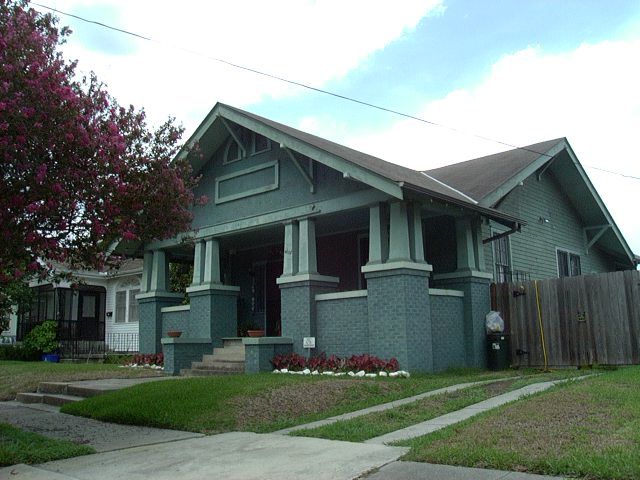
Residents with slab-on-grade homes were advised to covert their first floor into a garage and build a second floor with living quarters because the cost of raising the structure three feet is exorbitantly high.

Those with pier-and-beam homes were told to get started right away because the cost of raising a structure would rise with time. All were given architectural options that mimicked the many New Orleans styles.

"Do what you must do, but do it right," said Mr. Duany to the afternoon crowd assembled in a local church. "[City hall] will forgive anything if you do it right. You've got to get on with your lives."

But residents voiced concerns about building while the levees are still under repair. They are scheduled to be completed June 1, the start of the hurricane season, and should be able to handle Category 3 storms.

Duany assured residents that the levees would be excellent "because the honor of the nation depends on it. The levees are in better shape than they have ever been." But the reality, he said, is that rebuilding in New Orleans is a risk because the entire city is below sea level.

"We've been living with this risk all our lives so it's really a nonissue," said one resident.

"I just want people to know that they don't have to raise their homes at all," said another resident, referring to structures that are already three feet above the base flood elevation.

"Your flood insurance rates will be better if you do," added another resident.

"But they will go up rudely anyway," interjected Duany, as the designers buzzed in the background. "The simple fact is, a raised home looks better, has better curb appeal when it comes to resale."

Sure, slab-on-grade houses versus a raised-pier design and flood insurance is not the stuff of architecture school sketch problems but they are the kinds of things your average work-a-day architect deals with because it is what our clients deal with.

If we architects wish to play a positive role in rebuilding one of America's great cities, we need to be in the trenches, offering practical solutions for the rebuilding process, not trying to get the attention of design periodicals that most real people don't read.

Friday, April 21, 2006

Gentilly, My Lilly

The Times-Picayune finally has an article about the Gentilly Charette.

The media-savvy, 56-year-old Duany, who long ago gathered accolades and a measure of scorn after his design of the quaint Florida town Seaside, is tackling myriad planning questions in Gentilly. He is presiding over hearings, including one Thursday night, and work by dozens of volunteer architects and planners from around the country -- adherents of a New Urbanist movement that favors traditional city patterns friendly to pedestrians.

Duany wasn't asked by the LRA or Mayor Ray Nagin's recovery commission to lavish advice on Gentilly, still largely devoid of population. But he and a bevy of associates were pleased to be invited in by the Gentilly Civic Improvement Association, a key player in a grass-roots New Orleans planning movement.

Finally, local residents are taking the tiger by the tail in revitalizing the neighborhoods.

So what are Duany's goals?

  • "Try to salvage the dysfunctional and abandoned St. Bernard HUD housing project and, failing that, demolish and redesign it so that it works for people."
  • "Study the master plans for the universities of UNO, Dillard, Southern, improve them, and embed them into a functioning urban fabric." His references are to the University of New Orleans, Dillard University and Southern University at New Orleans.
  • "Consider the redesign of the existing, damaged, suburban houses which are in the majority in Gentilly in order to move them successfully toward a more urban condition."
The final presentation by Duany is set for Tuesday at 7 p.m. at St. Leo the Great Church on Paris Avenue.

As soon as the results are posted on the internet I'll provide a link.

Thursday, April 13, 2006

Film At Eleven

John Massengale of Veritas et Venustas has more about the Gentilly Charette here.

Tuesday, April 11, 2006

Culinary Architecture

The New Orleans City Council is hiring its own consulting group to help neighborhoods rebuild.

The council announced Friday that Paul Lambert and Shelia Danzey, its housing and neighborhood planning consultants, have begun working with neighborhoods that were devastated by Hurricane Katrina.

"Our goal is to respect the planning that has already gone on in the city and engage in recovery planning for the 49 neighborhoods that flooded," Lambert said.

"Our firms will serve as technical consultants to the neighborhood residents, building consensus from the ground up, in order to design true neighborhood plans," Danzey said.

The council passed a motion in December to engage Lambert and Danzey for these services, and it voted recently to spend nearly $3 million in Community Development Block Grant money on the process.

"We are going to insure that the city has a coordinated and community-supported plan to submit to Baton Rouge and Washington for funding," Councilwoman Renee Gill Pratt said.

This is something that should have been set in motion long ago. But although the scope of devestation is immense, so is the size of the team.

Working with Lambert and Danzey will be Miami architects and planners Alfredo Sanchez and Deborah Tackett, of Bermello-Ajamil & Partners, and New Orleans architect Lonnie Hewitt.

Sanchez led a neighborhood recovery planning effort for Miami-Dade County after Hurricane Andrew. Hewitt is the lead architect on the Pontchartrain Park and Gentilly Woods neighborhood planning process that began in December.

Other local architects and planners working with the group include Clifton James, Gerald Billes, Byron Stewart, James Washington, Joseph St. Martin, Deron Brown and James Baker. Also on the local team are consultants Silas Lee, who will conduct resident research and surveys; Greg Rigamer, who will provide data, mapping and geographic information systems analysis; and planner Steve Villavaso.

Also involved are Boston designer and planner M. David Lee, a professor of architecture at the Harvard University Graduate School of Design; and city planners Bernardo Zyscovich and Suria Yaffar of Zyscovich Inc. of New York and Miami. Zyscovich Inc. has developed master plans for many cities.

If there is one thing that I know about architects, is that they have egos. And with so many chefs stiring the pot, the kitchen is sure to get hot.

Monday, April 10, 2006

Gentilly Lace

Veritas et Venustas reports that New Orleans will finally get a design charette.

Some people don't understand. New Orleans had a disaster from which it may never recover. Its citizens are still scattered across the country. Helping New Orleans is not about urbanism versus Starchitecture, New Urbanism versus the avant garde, or style wars.

At long last, a little more than six months after Katrina, there will be a charrette in New Orleans. It won't fix New Orleans by itself, but it will help provide a better future for the city and its residents.

The team will assemble in New Orleans on April 17th 18th, and leave on the 26th 27th: I'm happy to say I'll be there. Presumably t There will be a public presentations at 7 pm on the 20th and the 22nd 18th, and the final presentation will be on the 25th 26th. Details to follow as available.

Film at eleven.