Monday, February 06, 2006

Good Enough For Government Work

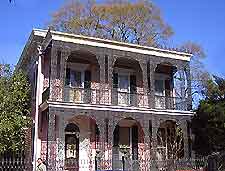
When the federal government gets into the business of providing temporary housing for displaced residents, this is what people get:

But when enterprising individuals get together to
devise a solution to the temporary housing issue, we get this:
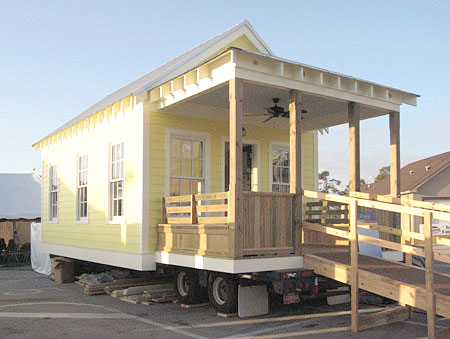


This cute little dwelling cost the same as a FEMA traier ($35,000) and has the same footprint (308 s.f.) and was built in 20 days. Mass produced, this could reasonably be halved.

A common question heard in south Louisiana is "Where is my FEMA trailer". After viewing the Katrina Cottage, as it has become known, a common question could be, "Where can I get one."

The yellow cottage with a tin roof is exactly the size of the temporary trailers the Federal Emergency Management Agency provides to victims of hurricanes and other disasters, and it costs about the same: less than $35,000.

But where a FEMA trailer looks grim and dispiriting - who wants to live next to one, let alone in one? - this house, known as the Katrina Cottage, is airy, bright and charming.

"I'm designing affordable housing," said Marianne Cusato, 31, the architect who designed the cottage. But developers who toured it, she said, were telling her they want to use the plans for upscale beach cottages or mountain resorts.

But FEMA seems to think that the trailer is all that citizens deserve, quote:
FEMA, for example, is not chartered to provide permanent housing...
The cottages, designed by Marianne Cusato, were originally designed to be "FEMA trailers with dignity," but have been so popular that people are inquiring about using them for hunting camps, mountain hide-aways and small vacation homes.

"Developer after developer came up to me, asking for the plans so they could build the cottage as beach-front housing or in ski resorts," she said.
But:

"I insisted that this is, first and foremost, emergency housing for the people of the Gulf Coast, but that once their needs have been met, I would consider it.

"Then it hit me that what I had done was to come up with a prototype that could take off as a new way of building," she said. "The irony is that these builders never realized that affordable housing can be attractive."

Well said.

More here, here and here.

Hat tip: Veritas et Venustas.

UPDATE: Prof. David J Peronnet, RA, NCARB is not impressed and I don't care.

It Was Supposed To Do That

The Corps of Engineers has been claiming the floodwalls that failed in New Orleans during Hurricane Katrina performed according to specifications and that the failures were due to the storm conditions exceeding the design specs. However, Engineer Manual No. 1110-2-2502 quashes that claim.

"It says what every engineer knows: If you build walls to 14 feet, regardless of the design specifications for the expected storm -- 12 feet or 10 feet or 13 feet -- those walls must hold water to their tops," said J. David Rogers, a forensic engineer on the National Science Foundation team investigating the failures.

"That's a basic rule in engineering, whether you're building dams or floodwalls. And those floodwalls were 14 feet in New Orleans, and all the evidence says they weren't overtopped.

"So, yeah, this was a human failure, not a natural disaster."

Quote:

Section 4b of the manual reads: "Case I2, Water to the Top of the Wall. This is the same as Case I1 (design flood loading) except the water level is at the top of the unprotected side of the wall."
But the Corps is still stuck on stupid:

(T)he corps commander, Brig. Gen. Carl Strock, said his agency believes Katrina was a Category 4 storm when it made landfall at Buras, and was a Category 5 when it was building storm surge in the Gulf that later fell on Louisiana. Corps officials say that the floodwalls and hurricane levees were designed to withstand the equivalent of "a fast-moving Category 3 storm."

But when Congress authorized the Lake Pontchartrain and Vicinity Hurricane Protection project in 1965, the now-familiar system of ranking hurricane intensity by Categories 1-5 was not in use. Instead, the corps was directed to protect the city from what the National Weather Service called the "Standard Project Hurricane." This is a once-in-300-years storm with maximum sustained winds of 100 mph in a 30-mile radius around the eye, traveling at an average speed of 6 mph, creating a storm surge on the south shore of Lake Pontchartrain of 11.5 feet.

Investigators believe the storm-surge reached a height of 10.5 feet before the floodwalls failed, one foot below the height mandated by Congress and 3.5 feet below its designed height.

So Engineer Manual No. 1110-2-2502 is the "Go Directly To Jail" card for the engineers. It doesn't matter what Congress mandates the Corps to build, it still has to comply with engineering standards. If a client hires me to design a three-story building without exit stairs and I build it, I'm at fault for not complying with the Life-Safety Code. God help us if people die in a fire in that building.

The Corps of Engineers must think it operates under its own rules.

Sunday, February 05, 2006

On Life Support, But Feeling Much Better Now

This is a Chicken Little moment for the Times-Picayune. Today's edition reports that, I kid you not, New Orleans hospitals are on "life support". Granted, waits at emergency rooms are extremely long and beds are in short supply. This may be difficult for the patients and the medical staff are stretched thin, but most businesses would see this as good news.

The only downside is that the hospitals are admitting a higher rate of uninsured, (yes, unisured DO have access to healthcare) and putting a financial strain on the institutions due to the charity system being shut-down.

The number of patients using emergency rooms for nonemergencies has a large role in the health care crisis, Peters said.

But further into the article we find that area hospitals are making adjustments to ease the load on the EDs.

In St. Bernard and Plaquemines parishes, federally financed clinics are available to residents. In Algiers, the Common Ground Collective, a grass-roots coalition, has opened a free clinic.

At West Jefferson Medical Center, the hospital has contracted with the nonprofit Jefferson Community Health Care Centers to set up an urgent-care facility outside West Jefferson's emergency room to care for patients with less serious injuries. The center takes patients on a sliding scale, meaning they pay less or nothing depending on their income and insurance.

"This is a new model of care for our community, and we're really proud of it," Muller said. "It creates access for patients, and avoids delays in the emergency room."

Carol Smith, executive director of Jefferson Community Health Centers, estimates that 65 percent of emergency room cases are not serious crises and can be handled at her facility, which opened on West Jefferson's campus in November. So far, the center is treating between 50 and 75 patients weekly, she said.

Such facilities not only provide immediate relief to area hospitals, but also to patients such as Tom Northrop, who suffered a paralyzing muscle spasm recently in Uptown New Orleans.


These urgent-care facilities are a somewhat recent concept in the healthcare industry. A number of hospitals, though not enough, are creating the facilities to to ease the demand on the costly ED and provide a shorter wait-time for the patient. The post-Katrina New Orleans now sees these as more necessary than ever.

But the problem could have been aleviated years ago if the Charity Hospital system in Louisian had been far-sighted enough to build these before. Because those unable to pay for healthcare were forced to go to the ED instead of their doctor, many chose not to receive proper care or those that did went to t0 the ED unnecessarily. Now DHH is looking into rebuilding a much smaller Charity Hospital along with numerous and smaller community clinics where residents can have shorter wait times closer to home and not be a burden on the much more expensive ED.

A few weeks after the storm, Congressman Bobby Jindal - (R) LA wrote an OpEd in September, 2005 challenging the state to rebuild our healthcare system as the best in the country.

The healthcare system has a great need for community-based outpatient, electronic patient records, bar coding of medical supplies and prescription drugs, and portable private insurance products that encourage patient empowerment.
These technologies are here already, we just need to spend the money to implement it.

We should listen to what Congressman Jindal has to say, not the Times-Picayune.

UPDATE: University Hospital will be opening about 14 ED bays in its now closed facility.

Saturday, February 04, 2006

Oops!

A litle error has huge consequences. According the Times Picayune:

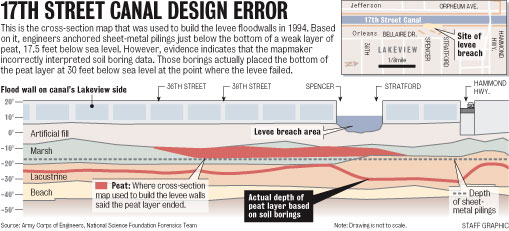
A difference in soil-boring data transferred from one chart to another may have played a key role in engineering decisions that led to the breach on the 17th Street Canal floodwall during Hurricane Katrina, National Science Foundation investigators say.

A cross-section drawing in the project design documents shows a weak layer of peaty soils between 11 feet and 16 feet below sea level in the area that failed during the storm. But information in the individual soil borings that were used to draw the cross section show the peaty layer extending as deep as 30 feet below sea level.
We all make mistakes, but doesn't anyone at these engineering firms check the work of another, especially when failures can be deadly.
Investigators also have been puzzled by what they say are obvious engineering errors because the firms involved -- Eustis Engineering for the soil profiles, Modjeski and Masters for the general design -- were experienced and reputable in their fields. Work by the National Science Foundation team, however, may have uncovered a small mistake that had a huge impact.

Thursday, February 02, 2006

Too Old To Die!

The National Trust for Historic Preservation in New Orleans and The Preservation Resource Center are attempting to prevent the demolition of many buildings in New Orleans deemed to be historic.

Next, the city hopes to demolish about 1,900 other buildings because they are deemed in danger of collapsing. The preservationists have looked at 199 of those buildings in the city's historic districts-many of them Creole cottages and cypress shotgun homes, trademark New Orleans structures based on French Caribbean and West African designs. The preservationists believe 71 are structurally sound and another 29 may be salvageable.

It looks the city and the preservationists have reached an agreement that is probably reasonable:

Greg Meffert, a city official who oversees permits and safety, said opponents to demolitions would have about three months to prove buildings should be removed from the demolition list. He said buildings that are found to be structurally sound could be saved.

While it would be a shame to demolish these historic structures, if they are indeed beyond repair, the city really has no choice to tear them down. The loophole that the preservationist have is that in order to be deemed beyond repair, often the inspectors will consider the cost of repair to greater that 50% the value of the building. Which is probably the case. The way out for the preservationist is to promise to the city is that a number of preservation organizations and individuals have pledged money to pay for the cost for repair. Assuming they have access to that kind of money. If I were them, I would immediately start requesting pledges from those interested and work out a deal.

In my experience, people in Safety & Permits can sometimes be pretty reasonable, if you talk nice to them. I'm sure the people in government would like to see historic building remain too.

Half A Loaf Is Not As Good As A Whole

Lolis Eric Elie asks a good question:

The Baker bill has all but achieved that status of a sacred text. It has become the rock on which our state is planning its rebuilding. But is our faith in it well-placed?
In a previous post, I urged people to support the Baker Bill. Being that it is the only plan to make homeowner financially whole, I am willing to accept a few warts. When the White House announced its opposition, South Louisianans faces turned red. I even sent an email to the White House stating my displeasure. And I'm a Bush supporter.

Here Mr. Elie makes an excellent point. Accepting the Baker Bill would be like taking a $1,500 settlement from the insurance company of the person who just totaled you Mercedes and sent you to the hospital to two-weeks. In other words, we deserve more. After all, it was negligence on the part of the federal government that resulted in the flooding of the city.

If homeowners who were flooded, even some who weren't, are able to sue the federal government - and that's a big if - the should be able to get a settlement worth hundreds of thousands of dollars. That's a lot better that 60 - 80% of the value of your home (assuming you still have a home).

When President Bush said that he needed a plan from the state, maybe that's what he had in mind? If it is, Louisiana need to bring a mindreader with them next time they visit Washington. What they'll probably do is continue to hold out their hand saying "Oh woe is us."

No More Jumbo Shrimp, Just Plain Shrimp

Gov. Kathleen "Drew a" Blanco is urging the reduction of the size of New Orleans government. To give you an idea of how bloated city government is, get this:

New Orleans has seven assessors; other parishes have one each. There are also two sheriffs in Orleans Parish — one criminal and one civil — where other parishes have one sheriff. And there are many more instances where Orleans Parish has elected and appointed offices unique to itself.
Hopefully this will end the trend of city government getting bigger as the population shrinks. Bloated and expensive governement, confiscatory taxes, an uneducated workforce, high crime rates, extensive welfare rolls and corrupt government officials is no way to attract new businesses and expand the tax base. It is a good way to begin a long, slow death spiral.

If the agenda on the special session are approved, New Orleans may be on its way to a long recovery.

In a similar vein, the Boston Globe editorializes that the recovery effort is anemic at best and this some of Bring New Orleans Back Commission's priorities may be misplaced.
Finally, and bizarrely, the report spends as much space on a light rail system as it does on levees. One could easily get the idea that the best protection against future hurricanes for the federal government to spend $5 billion on light rail in New Orleans. Light rail systems almost never cover their costs, and they are almost always dominated by high speed buses on dedicated lanes.
The city needs to set priorties. Right now everything is being thrown into the mix. That gives us the ability to see what is available long term and short term. I think the Globe misses that. And that is what the Bring New Orleans Back Commission report did, throw everything into the mix and let residents decide what is more important and what is less. Unfourtunately, many residents missed that point too.

I think the priorities should be as such:
  1. Rebuild and strengthen the levees and improve flood control.
  2. Clean out the political institutions. We will never be able to get ahead with the current crop of politicians keeping the populace down.
  3. Financial assistance for those who lost their homes and business. The federal government is at fault for that and therefore should pay. Just like the private sector.
  4. Resonstruct the healthcare system. Tenet Healthcare has committed to rebuilding at least one of it's hospitals in the city.
  5. Streamline city government to a size appropriate to the population and the basic of needs of the citizenry. This includes the unincorporation of a large chunk of the city.
  6. Replace the education system. The old system is broke beyond repair. Already several schools have reopened as charter schools. This bodes well for the city.
  7. Upgrade the infrastructure. Water, sewer, power and communications need to be brought into the 21st century.
  8. Start thinking about ways to connect SE Louisiana with the rest of the Gulf Coast. Were all in this together and it is in all our best interests to rebuild in sync.
  9. Improve the transportation systems. The mass transit system was in workable order but there is room for improvement.
  10. City beautification. The historic areas of New Orleans have an inner beauty that cannot be taken away but we should not have to look hard to see it.
  11. Recreational facilities. This should include renovation of West End and City Park, recreation complexes such as soccer fields (City Park already has a few softball diamonds) or other green spaces where informal games could be played. But, if we do this, they must be well maintained or we should not do it at all. If we are successfull in the former endeavors, New Orleaneans will have more time for recreation.
  12. Better development of the lakefront. Previously this had been the playground of the Orleans Levee District. Now that it will probably go away sometime after the latest special session of the legislature, the city needs to work in conjunction with the new levee board to ensure that flood control does not have to come at the expense of New Orleans best assets.
Quite a dilema we have, thinking smaller while seeing the big picture at the same time.

Wednesday, February 01, 2006

Got Stung By A Hornet

The New Orleans Hornets will remain based in Oklahoma City for next season. There is a possibility that the team will return to the Crescent City for the 2007-2008 season.

Sports fans around New Orleans are beginning to show signs of "battered-wife syndrome. First, Tom Benson, owner of the Saints, toyed with the idea of moving to San Antonio, ony to lie about really wanting to return and then being basically ordered by the NFL to come back. Now were taking the same treatment from our other sports franchise.

Well, at least the Zephyrs still treat us like a lady.

Sid Mar's Falls On Its Sword

Sid Mar's Restaurant in Bucktown and Coconut Beach Volleyball Complex at West End will be sacrificed in order to construct a temporary floodgate and pumping station. While I have never been to Sid Mar's, other like it have been fequented many time my wife and I to enjoy the simple menus of fried seafood, generous portions and relaxed atmosphere.

Although I haven't played volleyball in ten years, I remember the summer our firm played in Coconut Beach's summer league like it was yesterday. June and July in New Orleans can be the epitomy of hot and humid, but having a couple of cold beers after a game of volleyball next to Lake Ponchartrain was never more pleasant.

Now they may never return but I'm going to be an optimist and await the day when each opens in a new location nearby.

While saddened by their loss Sid-Mar’s operator Kent Burgess is philosophical about it:

Burgess said he knows the greater good – the protection of life – has to take precedence over rebuilding the restaurant, but he said the thought hurts.

The whole area known as West End took a beating during Hurricane Katrina and before with other restaurants being lost or damaged during Hurricanes Georges and Ivan. The last storm devastated the area so much that it can only go up. Let's hope that West End is part of the rebuilding plan of New Orleans.

More about West End can be found at Wikitravel.

UPDATE: Graphic of proposed gate and pumps here. And it looks like the site for Coconut Beach will become available again.

Mississippi Building

According to the Providence Journal, the Mississippi will be rebuilding the old Gulf Coast anew. The article points out the conflict between the Modernists and the New Urbanists. This time the New Urbanists appear to have won out.

In contrast, the Mississippi charrette offers not just a great way to rebuild the Gulf Coast after Katrina; it offers all Americans a chance to re-acquaint themselves with what they have lost: the beautiful cities and towns that modernism everywhere has managed to destroy, starting half a century ago.

New Orleans is a case in point in that it never turned it's back on its historic roots, indeed, it imbraced it. Rebuilding New Orleans will not involve the kind of rebuilding going on in Mississippi, since we are not starting from scratch. We do need to be mindfull of those things that are repaired that they be done in a way that maintains the patina of the old city. It can't look too new or too slick. Distressed it good.

That's not to say we can't improve. The BNOB Commission rebuilding plan had some good ideas in expanding the streetcar lines and adding more green space (just not too much).

Also, the proposal to build a light rail connecting SE Louisiana with the rest of the Gulf Coast will be great for the region. With that visitors can experience the entire region instead of a particular town.

The City of New Orleans and the State of Louisiana have to get their act together and decide where they want to take our region. We're waiting.

Hat Tip: Veritas et Venustas.