Thursday, February 09, 2006

I Never Promised You A Rose Garden

Gulf Coast reconstruction czar Donald Powell got a lukewarm reception on Wednesday from a group of Louisiana bankers who challenged the former bank regulator on the speed of recovery and the true amount of federal dollars being devoted to the effort.
Bankers aren't the only ones not happy with the federal government's response to the Hurricane Katrina recovery effort. Most of south Louisiana is probably ready to secede from the Union if President Bush doesn't live up to his promise to rebuild the Gulf Coast.
But Powell offered little fresh insight into the federal government's plans for south Louisiana, insisting that local decisions must guide the rebuilding effort but that Washington remains a committed partner.
So now is the time for local residents to direct a lot of the pressure on our own politicians. As the second special session of the Louisian Legislature convenes, crucial issues that will determine the level of response from the federal government are being met with stiff resistance.

State Sen. Walter Boasso's, R-Arabi, bill to consolidate the various levee boards faces multiple obstacles as well as other proposals to consolidate New Orleans government.

These changes need to be made regardless of Washington's wishes and it's a shame that it takes that kind of prodding to make it happen. If change does happen, I expect President Bush to live up to his word and help us rebuild as he promised. Otherwise he'll be referred to as being all hat and no cattle around these parts. If change does not happen, Louisiana politicians will be known as dead men walking.

Wednesday, February 08, 2006

Start Me Up, With Or Without You

Some New Orleans homeowners are breaking the law in order to have electricity restored to their homes. That shows the level of frustration that residents are dealing with when trying to move back into the city.

Vine, a building contractor, broke the law and risked serious injury or death. But like so many others in this hurricane-ravaged city, he figured it was the only way to avoid the red tape and hair-pulling frustration so many have faced in trying to get their electricity restored.

"People cannot possibly do this by the book and stay in the city," said Vine, who lives a block from one of the city's former mayors in the upper-middle-class Broadmoor neighborhood.

Last month I posted an article about the City of New Orleans waiving its requirement to obtain a permit prior to starting electrical work. What the article failed to mention is that inspections are still required. And therin lies the rub. You see, New Orleans has only six electrical inspectors for about 124,000 homes and businesses that were flooded. That's a helluva bottleneck.

But as usual, lawyers are throwing wrenches into the works:

"We can't waive the inspection because unfortunately the liability would be too great," said Clinton Vince, an attorney who advises the City Council's utilities committee. "The electrical work needs to be inspected because if the wire is not installed properly, it could cause serious safety problems — including loss of life."
I think homeowners understand the risk posed by playing with electricity. That's why they hire electricians. At least other city administrators understands that "These are extraordinary times."

One Hero Sandwich, Hold The Mayo

The rebuilding of the Gulf Coast and New Orleans is offering the opportunity for those of us in the design community to debate the pros and cons of Modernism and New Urbanism.

Modernists look down upon the New Urbanists as wanting an unispired Disneyification of American cities. New Urbanists see Modernists as a bunch of ego maniacs determined to strip away all that familiar to residents to build their perceived utopian societies. Both may be correct and both may be wrong. I think both sides have something to offer and it is up to us to decide learn what each side has to offer and what will work best for us.

corbusier at Architecture and Morality writes about the "...abandon(ment of) the modernist style for a historicist one." as developers and architects seek to recreate foreign environments seemingly out of place from their locale. This may be fine for resorts as they are just that, resorts. People go their to escape the familiar. And if it has to be make-believe, make it so.

That differs from where people live and work. They mostly want the familiar. When architect Marianne Cusato designed the "Katrina Cottage", many people wanted to know where could they get one. One the other hand, acedemics like Prof. Peronnet scoffed, saying it is "a decorated shed on wheels" and that we as architects should promote "responsibility to truth and technology or better yet the promotion of architects as professionals, trained to truly solve life threatening problems and not color schemes and rafter tails."

What we need to remember is that we have a responsibility to our clients, that is if we want to be considered professionals. If our clients want the familiar, it is our duty to provide it for them. If our client wants outlandish, it is our duty to provide it, as best we can. We should not be in the habit of turning up our noses at the choices of our clients, although sometimes they deserve it.

So why the upturned noses at the "Katrina Cottage"?

If (one)looked inside the Katrina cottage and saw how the space was used maximizing each square inch, he would see inventive.
Furthermore:
These designs have been proven to stand up to the wind, rain and heat, that all Southerns must deal with through out the year. I can tell you with out a doubt that here in the south we love our beautiful small buildings with porches so we can sit and enjoy summer afternoons, we like overhaning roofs, they sheds rain quickly and keep our windows dry in downpours, we like big windows for viewing tranquill gardens shaded by magnificent oaks.
We as architects need to get off our high-horse and show a little respect for the wishes of the people because they are the ones who suffer most when designs go wrong. So yes, I love the "Katrina Cottage" and continually kick myself for not coming up with it first.

Tuesday, February 07, 2006

NO East, No Mo'?

New Orleans East used to contain approximately 20% of the city's population on about 60% of the land area. Now it is mostly empty. With the exception of the reopened Home Depot, about the only activity seen today is the occasional clean-up crews, and they are now a rare sight.

I was the home to many of the city's black professionals. Now they have not patients to save, not clients to serve. And the future of New Orleans is in doubt. At least that's the impression Bloomberg.com give in this article.

``It should never have been built on,'' architect Allen Eskew told me as we toured the debris-filled streets.
I think the article is unduly pessimistic. Unseen to most, some people have moved back into their homes and an entire Vietnamese community has rebuilt and moved home completely below the media radar screen.

But because of the East's light population density and large undeveloped tracks of land (such as Bayou Sauvage N.W.R.), having that part of the parish does not make any sense. As I've said in a previous post, if the city footprint needs to be reduced, a simple solution (not politically that is) is to unincorporate everything east of the Industrial Canal - except the Lower Ninth Ward and Holy Cross. However, residents who wish to return, the government should not prevent them, but they need to be aware that they will not be able to receive the same city services that they are used to.

This is not to say that NO East will be living in the Wild East, the Parish of Orleans will be obligated to provide law enforcement as well as public schools. Both of these organizations are parish wide. Entergy is not about to turn down paying customers - despite what its CEO says. The Parish of Jefferson is mostly unincorporated and yet is one of the most prosperous parishes in the state. Orleans should follow its example.

Its time for the City of New Orleans to stop talking about what needs to be done and simply do it. People are waiting for the city to take action so that they can make their decision. The indecision of the governments is what's killing us.

Monday, February 06, 2006

Good Enough For Government Work

When the federal government gets into the business of providing temporary housing for displaced residents, this is what people get:

But when enterprising individuals get together to
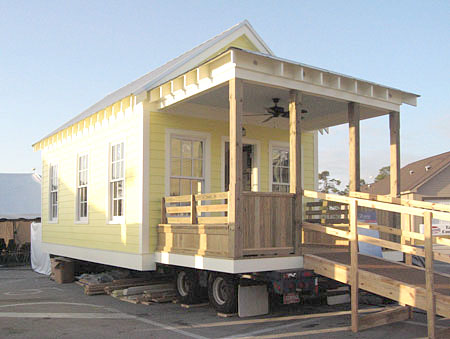
devise a solution to the temporary housing issue, we get this:


This cute little dwelling cost the same as a FEMA traier ($35,000) and has the same footprint (308 s.f.) and was built in 20 days. Mass produced, this could reasonably be halved.

A common question heard in south Louisiana is "Where is my FEMA trailer". After viewing the Katrina Cottage, as it has become known, a common question could be, "Where can I get one."

The yellow cottage with a tin roof is exactly the size of the temporary trailers the Federal Emergency Management Agency provides to victims of hurricanes and other disasters, and it costs about the same: less than $35,000.

But where a FEMA trailer looks grim and dispiriting - who wants to live next to one, let alone in one? - this house, known as the Katrina Cottage, is airy, bright and charming.

"I'm designing affordable housing," said Marianne Cusato, 31, the architect who designed the cottage. But developers who toured it, she said, were telling her they want to use the plans for upscale beach cottages or mountain resorts.

But FEMA seems to think that the trailer is all that citizens deserve, quote:
FEMA, for example, is not chartered to provide permanent housing...
The cottages, designed by Marianne Cusato, were originally designed to be "FEMA trailers with dignity," but have been so popular that people are inquiring about using them for hunting camps, mountain hide-aways and small vacation homes.

"Developer after developer came up to me, asking for the plans so they could build the cottage as beach-front housing or in ski resorts," she said.
But:

"I insisted that this is, first and foremost, emergency housing for the people of the Gulf Coast, but that once their needs have been met, I would consider it.

"Then it hit me that what I had done was to come up with a prototype that could take off as a new way of building," she said. "The irony is that these builders never realized that affordable housing can be attractive."

Well said.

More here, here and here.

Hat tip: Veritas et Venustas.

UPDATE: Prof. David J Peronnet, RA, NCARB is not impressed and I don't care.

It Was Supposed To Do That

The Corps of Engineers has been claiming the floodwalls that failed in New Orleans during Hurricane Katrina performed according to specifications and that the failures were due to the storm conditions exceeding the design specs. However, Engineer Manual No. 1110-2-2502 quashes that claim.

"It says what every engineer knows: If you build walls to 14 feet, regardless of the design specifications for the expected storm -- 12 feet or 10 feet or 13 feet -- those walls must hold water to their tops," said J. David Rogers, a forensic engineer on the National Science Foundation team investigating the failures.

"That's a basic rule in engineering, whether you're building dams or floodwalls. And those floodwalls were 14 feet in New Orleans, and all the evidence says they weren't overtopped.

"So, yeah, this was a human failure, not a natural disaster."

Quote:

Section 4b of the manual reads: "Case I2, Water to the Top of the Wall. This is the same as Case I1 (design flood loading) except the water level is at the top of the unprotected side of the wall."
But the Corps is still stuck on stupid:

(T)he corps commander, Brig. Gen. Carl Strock, said his agency believes Katrina was a Category 4 storm when it made landfall at Buras, and was a Category 5 when it was building storm surge in the Gulf that later fell on Louisiana. Corps officials say that the floodwalls and hurricane levees were designed to withstand the equivalent of "a fast-moving Category 3 storm."

But when Congress authorized the Lake Pontchartrain and Vicinity Hurricane Protection project in 1965, the now-familiar system of ranking hurricane intensity by Categories 1-5 was not in use. Instead, the corps was directed to protect the city from what the National Weather Service called the "Standard Project Hurricane." This is a once-in-300-years storm with maximum sustained winds of 100 mph in a 30-mile radius around the eye, traveling at an average speed of 6 mph, creating a storm surge on the south shore of Lake Pontchartrain of 11.5 feet.

Investigators believe the storm-surge reached a height of 10.5 feet before the floodwalls failed, one foot below the height mandated by Congress and 3.5 feet below its designed height.

So Engineer Manual No. 1110-2-2502 is the "Go Directly To Jail" card for the engineers. It doesn't matter what Congress mandates the Corps to build, it still has to comply with engineering standards. If a client hires me to design a three-story building without exit stairs and I build it, I'm at fault for not complying with the Life-Safety Code. God help us if people die in a fire in that building.

The Corps of Engineers must think it operates under its own rules.

Sunday, February 05, 2006

On Life Support, But Feeling Much Better Now

This is a Chicken Little moment for the Times-Picayune. Today's edition reports that, I kid you not, New Orleans hospitals are on "life support". Granted, waits at emergency rooms are extremely long and beds are in short supply. This may be difficult for the patients and the medical staff are stretched thin, but most businesses would see this as good news.

The only downside is that the hospitals are admitting a higher rate of uninsured, (yes, unisured DO have access to healthcare) and putting a financial strain on the institutions due to the charity system being shut-down.

The number of patients using emergency rooms for nonemergencies has a large role in the health care crisis, Peters said.

But further into the article we find that area hospitals are making adjustments to ease the load on the EDs.

In St. Bernard and Plaquemines parishes, federally financed clinics are available to residents. In Algiers, the Common Ground Collective, a grass-roots coalition, has opened a free clinic.

At West Jefferson Medical Center, the hospital has contracted with the nonprofit Jefferson Community Health Care Centers to set up an urgent-care facility outside West Jefferson's emergency room to care for patients with less serious injuries. The center takes patients on a sliding scale, meaning they pay less or nothing depending on their income and insurance.

"This is a new model of care for our community, and we're really proud of it," Muller said. "It creates access for patients, and avoids delays in the emergency room."

Carol Smith, executive director of Jefferson Community Health Centers, estimates that 65 percent of emergency room cases are not serious crises and can be handled at her facility, which opened on West Jefferson's campus in November. So far, the center is treating between 50 and 75 patients weekly, she said.

Such facilities not only provide immediate relief to area hospitals, but also to patients such as Tom Northrop, who suffered a paralyzing muscle spasm recently in Uptown New Orleans.


These urgent-care facilities are a somewhat recent concept in the healthcare industry. A number of hospitals, though not enough, are creating the facilities to to ease the demand on the costly ED and provide a shorter wait-time for the patient. The post-Katrina New Orleans now sees these as more necessary than ever.

But the problem could have been aleviated years ago if the Charity Hospital system in Louisian had been far-sighted enough to build these before. Because those unable to pay for healthcare were forced to go to the ED instead of their doctor, many chose not to receive proper care or those that did went to t0 the ED unnecessarily. Now DHH is looking into rebuilding a much smaller Charity Hospital along with numerous and smaller community clinics where residents can have shorter wait times closer to home and not be a burden on the much more expensive ED.

A few weeks after the storm, Congressman Bobby Jindal - (R) LA wrote an OpEd in September, 2005 challenging the state to rebuild our healthcare system as the best in the country.

The healthcare system has a great need for community-based outpatient, electronic patient records, bar coding of medical supplies and prescription drugs, and portable private insurance products that encourage patient empowerment.
These technologies are here already, we just need to spend the money to implement it.

We should listen to what Congressman Jindal has to say, not the Times-Picayune.

UPDATE: University Hospital will be opening about 14 ED bays in its now closed facility.

Saturday, February 04, 2006

Oops!

A litle error has huge consequences. According the Times Picayune:

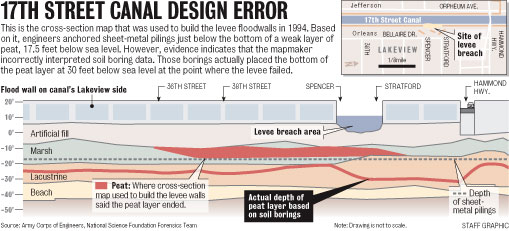
A difference in soil-boring data transferred from one chart to another may have played a key role in engineering decisions that led to the breach on the 17th Street Canal floodwall during Hurricane Katrina, National Science Foundation investigators say.

A cross-section drawing in the project design documents shows a weak layer of peaty soils between 11 feet and 16 feet below sea level in the area that failed during the storm. But information in the individual soil borings that were used to draw the cross section show the peaty layer extending as deep as 30 feet below sea level.
We all make mistakes, but doesn't anyone at these engineering firms check the work of another, especially when failures can be deadly.
Investigators also have been puzzled by what they say are obvious engineering errors because the firms involved -- Eustis Engineering for the soil profiles, Modjeski and Masters for the general design -- were experienced and reputable in their fields. Work by the National Science Foundation team, however, may have uncovered a small mistake that had a huge impact.

Thursday, February 02, 2006

Too Old To Die!

The National Trust for Historic Preservation in New Orleans and The Preservation Resource Center are attempting to prevent the demolition of many buildings in New Orleans deemed to be historic.

Next, the city hopes to demolish about 1,900 other buildings because they are deemed in danger of collapsing. The preservationists have looked at 199 of those buildings in the city's historic districts-many of them Creole cottages and cypress shotgun homes, trademark New Orleans structures based on French Caribbean and West African designs. The preservationists believe 71 are structurally sound and another 29 may be salvageable.

It looks the city and the preservationists have reached an agreement that is probably reasonable:

Greg Meffert, a city official who oversees permits and safety, said opponents to demolitions would have about three months to prove buildings should be removed from the demolition list. He said buildings that are found to be structurally sound could be saved.

While it would be a shame to demolish these historic structures, if they are indeed beyond repair, the city really has no choice to tear them down. The loophole that the preservationist have is that in order to be deemed beyond repair, often the inspectors will consider the cost of repair to greater that 50% the value of the building. Which is probably the case. The way out for the preservationist is to promise to the city is that a number of preservation organizations and individuals have pledged money to pay for the cost for repair. Assuming they have access to that kind of money. If I were them, I would immediately start requesting pledges from those interested and work out a deal.

In my experience, people in Safety & Permits can sometimes be pretty reasonable, if you talk nice to them. I'm sure the people in government would like to see historic building remain too.

Half A Loaf Is Not As Good As A Whole

Lolis Eric Elie asks a good question:

The Baker bill has all but achieved that status of a sacred text. It has become the rock on which our state is planning its rebuilding. But is our faith in it well-placed?
In a previous post, I urged people to support the Baker Bill. Being that it is the only plan to make homeowner financially whole, I am willing to accept a few warts. When the White House announced its opposition, South Louisianans faces turned red. I even sent an email to the White House stating my displeasure. And I'm a Bush supporter.

Here Mr. Elie makes an excellent point. Accepting the Baker Bill would be like taking a $1,500 settlement from the insurance company of the person who just totaled you Mercedes and sent you to the hospital to two-weeks. In other words, we deserve more. After all, it was negligence on the part of the federal government that resulted in the flooding of the city.

If homeowners who were flooded, even some who weren't, are able to sue the federal government - and that's a big if - the should be able to get a settlement worth hundreds of thousands of dollars. That's a lot better that 60 - 80% of the value of your home (assuming you still have a home).

When President Bush said that he needed a plan from the state, maybe that's what he had in mind? If it is, Louisiana need to bring a mindreader with them next time they visit Washington. What they'll probably do is continue to hold out their hand saying "Oh woe is us."